 |
String dampers
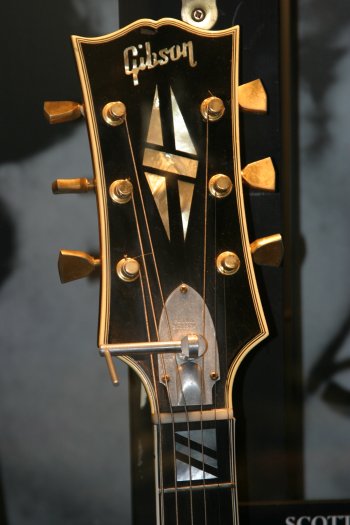
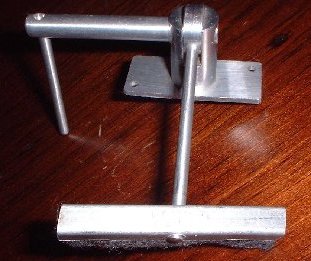
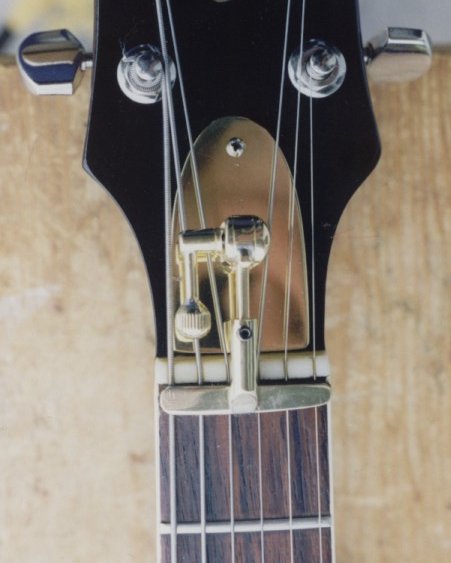
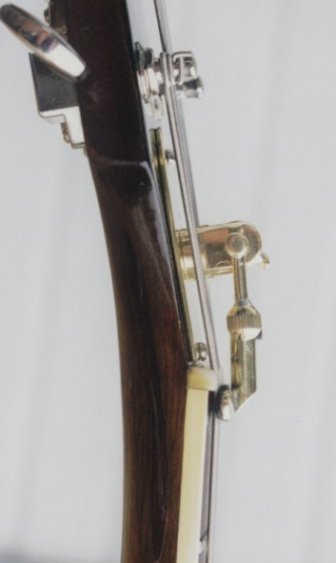
Scotty's 63 Super 400 CES, like the guitars of many jazz players of the 60's, featured a string damper which helped eliminate feedback This style of string damper is from a design by the famous Jazz guitarist George Van Eps and used by other players of note like Herb Ellis. The damper, mounted on a plate which replaced the original trussrod cover was designed to damp down unwanted open string overtones. This helped achieve a better tonal balance between open and fretted notes, whilst reducing the electro-acoustic guitar's susceptibility to feedback. Van Eps dampers were available as a guitar accessory throughout the fifties although Gibson did market them for a short period, which linked them with the company name.
Beginning with that guitar Scotty employed another means of damping also. This involved the placement of a felt or sponge beneath the strings between the bridge and tailpiece. He's used that method on all his guitars since and finds it also a handy place to store spare guitar picks.
In a search for information regarding Van Eps dampers and in an attempt to locate one I corresponded with several individuals, two of which, Pat Farrand and Mavin Dodge have been extremely informative.
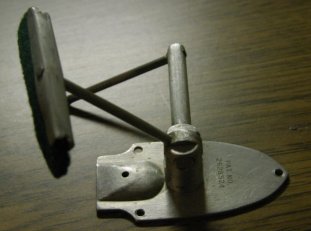
In the 1960's I worked at Valley Sound in Hollywood. While there, I did repairs for Herb Ellis and became acquainted with the Van Epps damper. Over the years I had occasion to repair Herb's damper, and became acquainted with George Van Epps who lived close by. Several years ago Herb's damper fell apart and he sent it to me. I took it to George, but George said it was beyond repair. George had quite a collection of spare parts and dampers that he never finished, so he arranged to build one for Herb and send it to him. I offered to buy George's parts collection, but he did not want anyone else assembling his dampers. I have only one damper remaining and it is an "odd-ball" unit. George said it was one manufactured by the Gibson company as a prototype of one they wanted to put into production under a license he gave them in the late 50's. He cancelled Gibson's license after less than a year and never let them go into production. George believed that less than 5 or 10 of these prototype units were ever produced (I did not know this history when I bought it 30 years ago). I used this "Gibson damper" on a succession of guitars over the years, and it worked OK but is in fact ugly when compared to one of George's hand made units. There are so few of George's dampers around that George himself could not locate a working model for Herb. Herb thought that Barney Kessel had several, but when I contacted Barney he said he sold them along with the guitars they were mounted on. I wouldn't know where to even begin looking for an original Van Epps damper at this time.
I had a lot of trouble over the years finding replacement felt for the damper. The best I could do is use standard one inch piano felt (which is close to the right thickness), and then splitting it down to the 1/4 width. I tried securing it with rubber bands and wire, and finally resorted to "pinching" the sides of the slot with pliers (that's why it looks a little rough in spots. In any case, it works fine in the down position with the felt against the strings. By the way, this is the damper I loaned to Herb Ellis several years ago until George Van Epps could send him a replacement. By the way, the trick of using piano felt between the bridge and the tail piece is common. A metal tail piece produces a harmonic "over-ring" that can be very disturbing to a sensitive ear. I used the same trick for many years. Now, I change all tailpieces to the wooden "cello" type secured by a threaded nylon strap around the end pin. This looks more natural and stops the metallic over-ring problem. By the way, the string dampers that Pat makes are real works of art, and dampen better than the Van Epps. George would have loved the workmanship. I'm sure he would have argued for a quick release "spring-and-ball" locking system (like his design), rather than the "pressure lever" Pat uses. I've learned to operate mine with one hand, but George's design allows the player flip the damper up (to expose the open strings) while on the fly. With Pat's damper the player must stop playing for a few seconds, or position it up before beginning a tune that requires open strings. Mavin Dodge April 5, 2003
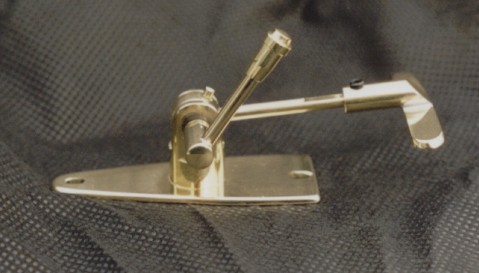
I custom build string dampers. Mine are all brass and sit in place of the truss rod cover. Mine differs from the Van Eps in that it has a much lower profile so there is no interference to the fretting hand. They are very adjustable for amount of damping required and don't 'choke' the natural sound. If you are only interested in the Van Eps, they can be found. Some of my customers own one but they usually like to keep them as a piece of history. Gibson also produced one for a short time in the mid sixties under license from George Van Eps. Still, there are relatively few in existence. The Damper shown on Scotty's Super 400 appears to be a Gibson made, George Van Eps licensed model. It wasn't easily adjustable and was rather large. George used aircraft aluminum to build the mechanism and the Damper itself was slotted and used a piano 'felt' insert that contacted the strings. I have seen, and customers of mine have described, a number of variations made by Van Eps. Mavin Dodge in California has one. He told me he saw Herb Ellis' disassemble on stage one night. Pat Farrand
March 24, 2003 ** Pat Farrand or his dampers are not affiliated with Scotty Moore or his website but was kind enough to provide info and pictures about them to be used here. If any readers are interested in one of his custom built dampers please contact him directly by email at "pfarrand @ sherbtel.net", by phone at (763) 263 6910 or send a self addressed stamped envelope to him at: 16324 171st Ave. S.E., Big Lake, MN 55309 USA
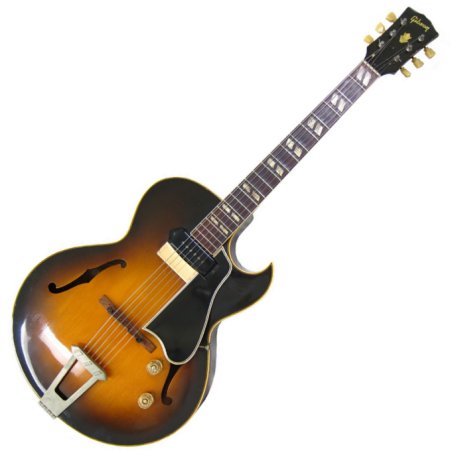
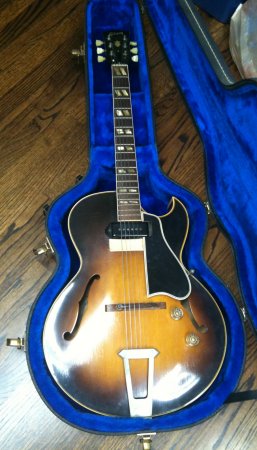
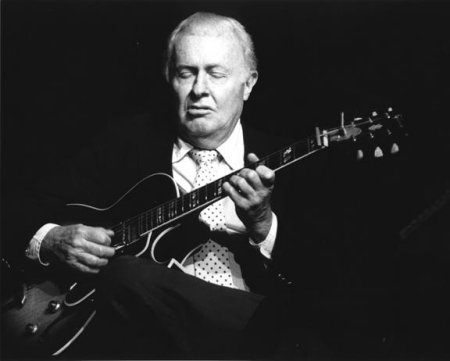
On March 28, 2010, jazz guitarist Herb Ellis passed away at the age of 88. Having written about him briefly on this site as a user of the Van Epps dampers like Scotty had on a couple of his guitars, I was contacted a few days later by Tye Rubins who has what he believes to be the first ES 175 owned by Herb. I thought it fitting in honor of Herb to share his story and pictures here: Hi Jim I have owned Herb Ellis' original Gibson ES 175 for almost 50 years.
I bought this from Phil Spector in 1959. I was friends with Elliot Ingber who was a founding member of Frank Zappa's Mothers of Invention. The guitar was under Elliot's bed. I pulled it out and asked who it belonged to. He said it belong to Phil who was in New York working with Lieber and Stoller writing songs. I called Phil, bought it from him and sent him money.
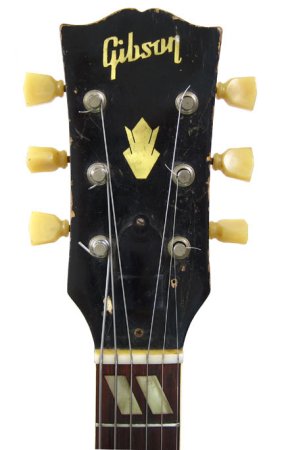
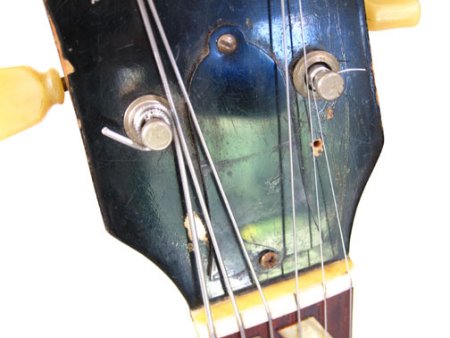
Phil told me he bought this guitar from Herb Ellis. I have no reason to doubt that this is Herb Ellis' first Gibson 175. It even has the offset screw holes from the Van Eps Damper that was on it and a mark where the damper sat. He moved the surface mounted pickup which required that the pick guard be notched and bandage tape put over the hole. At the time I didn't think much of it since I only paid Phil $41 for it.
Its serial number is A6870 which puts it in 1950-51. I believe it may have been on Phil's first hit, "To Know Him Is To Love Him" with the Teddy Bears.
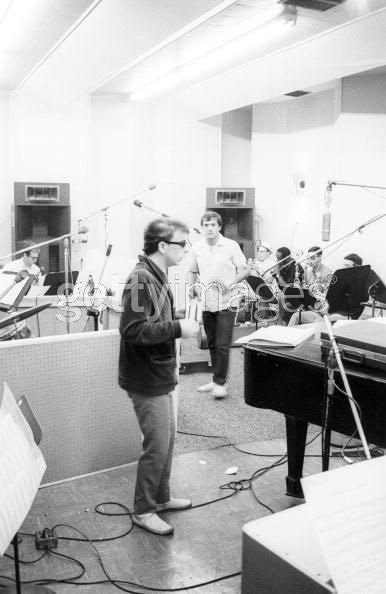
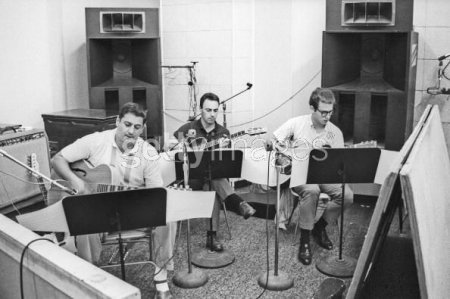
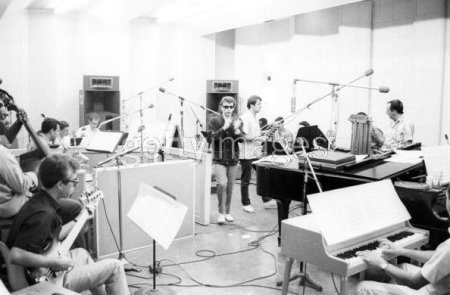
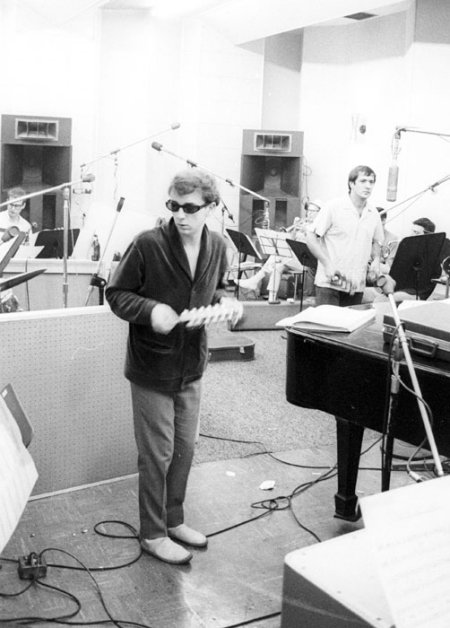
Phil and I went to Fairfax High at the same time, but he graduated before me. I was a member of the Wall of Sound in 1960-61. I had the least amount of talent and was the only non-union player because Phil wanted the sound from his Gibson 175 on these records for good luck. He did get that. My name is on all of those records as Irv Rubins.
I've included pictures with me playing the guitar at Gold Star Studios. At the center front right to left is Sonny Bono, Phil Spector and me in the back.
If you think Herb Ellis had an earlier 175 that he modified, I like to know.
added April 2, 2010
|
|
All photos on this site (that we didn't borrow) unless otherwise indicated are the property of either Scotty Moore or James V. Roy and unauthorized use or reproduction is prohibited. |