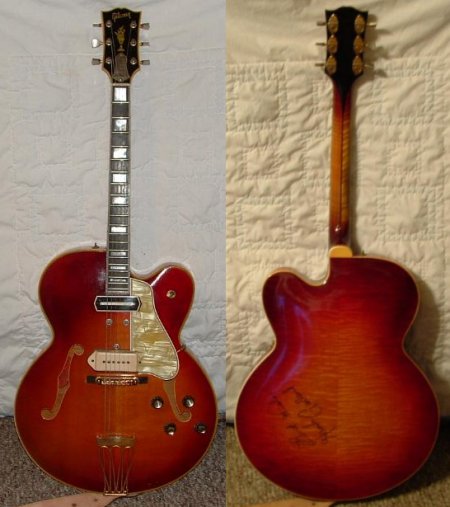
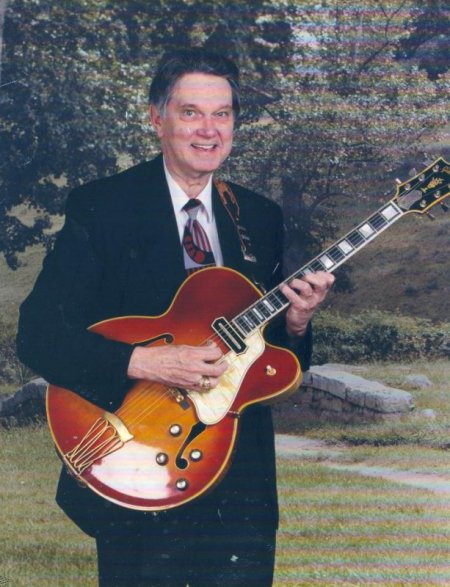
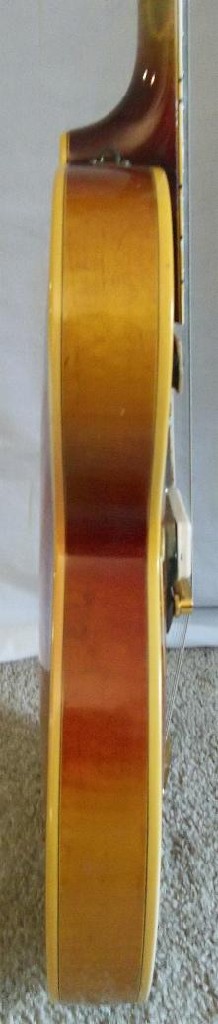
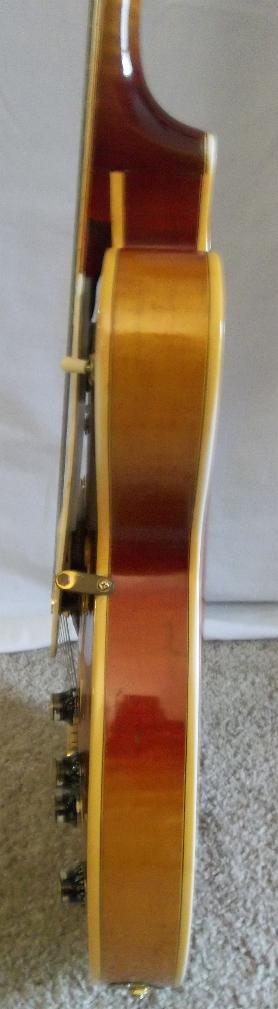
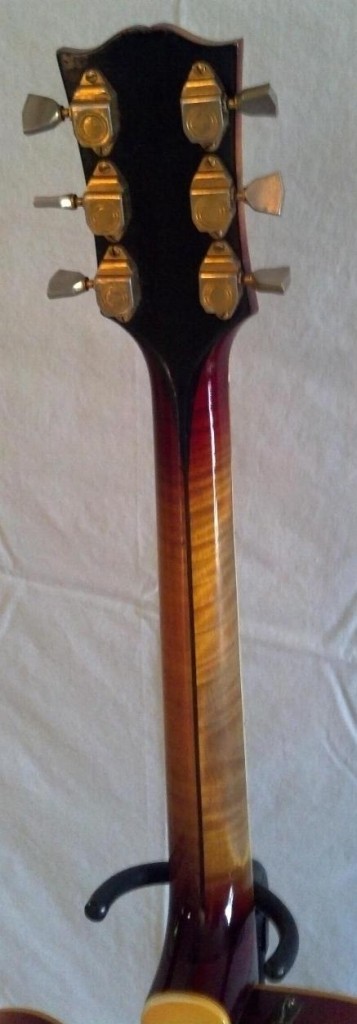
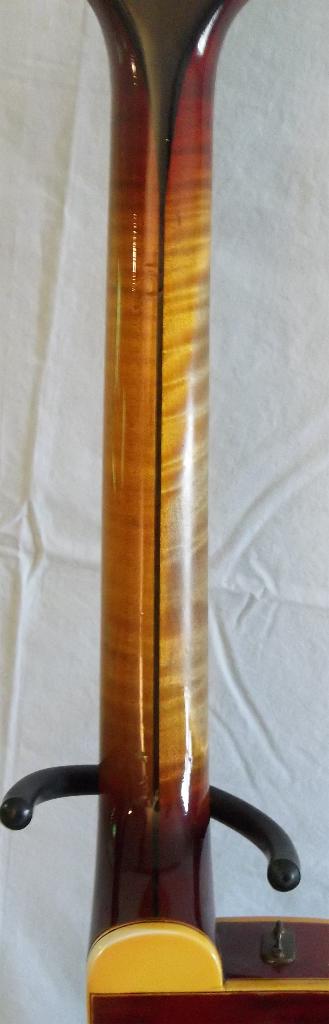
1955 #3 Gibson Byrdland
Photo courtesy Allen Arnold
In 1955 in collaboration with Nashville guitarists Billy Byrd and
Hank Garland, Gibson developed the Byrdland guitar, the name of which is derived from their last names. Only three were produced in
1955. Billy is assumed to have got #1, Hank #2 and then a third with a Cherry sunburst finish was ordered by Hank.
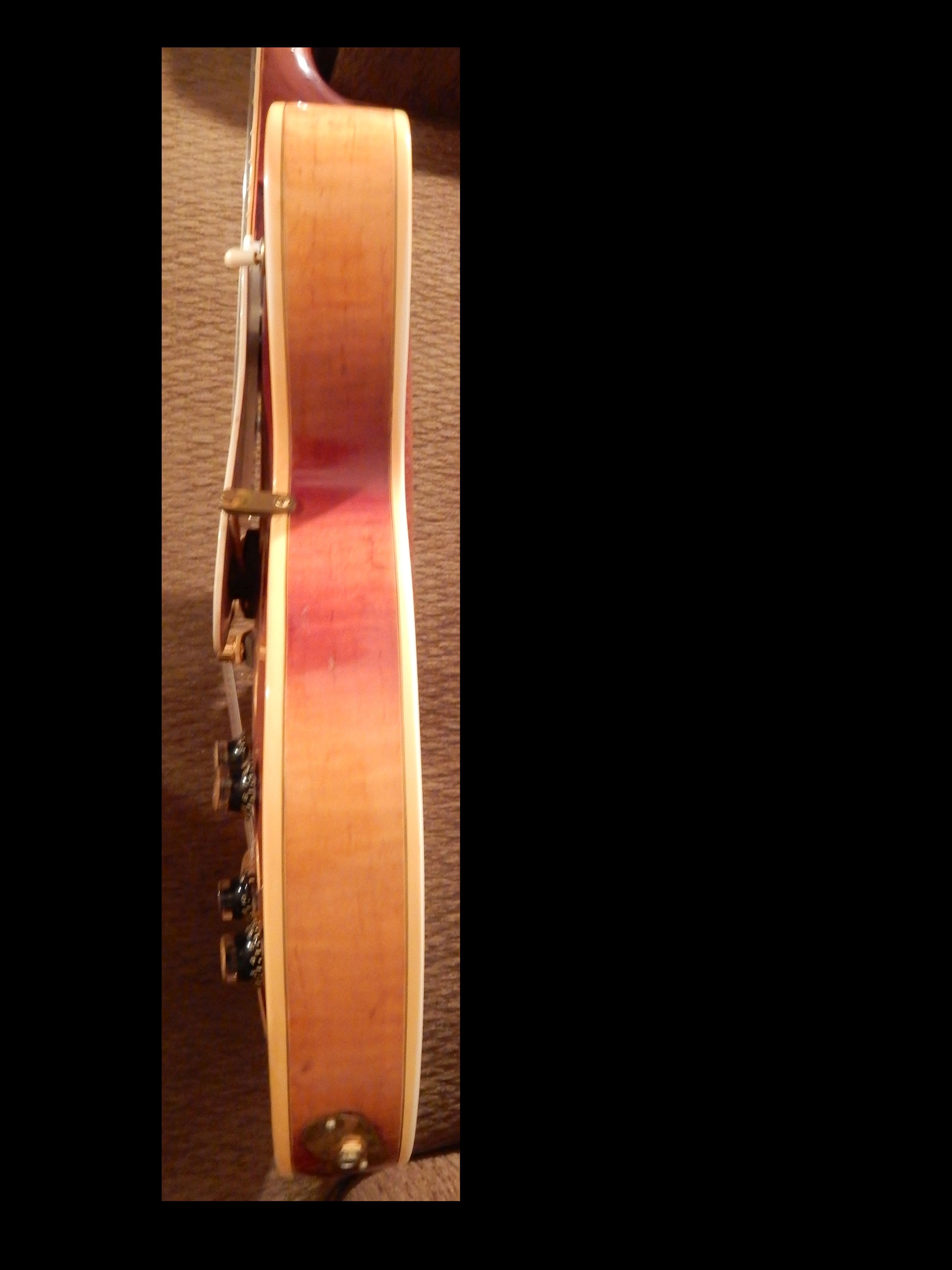
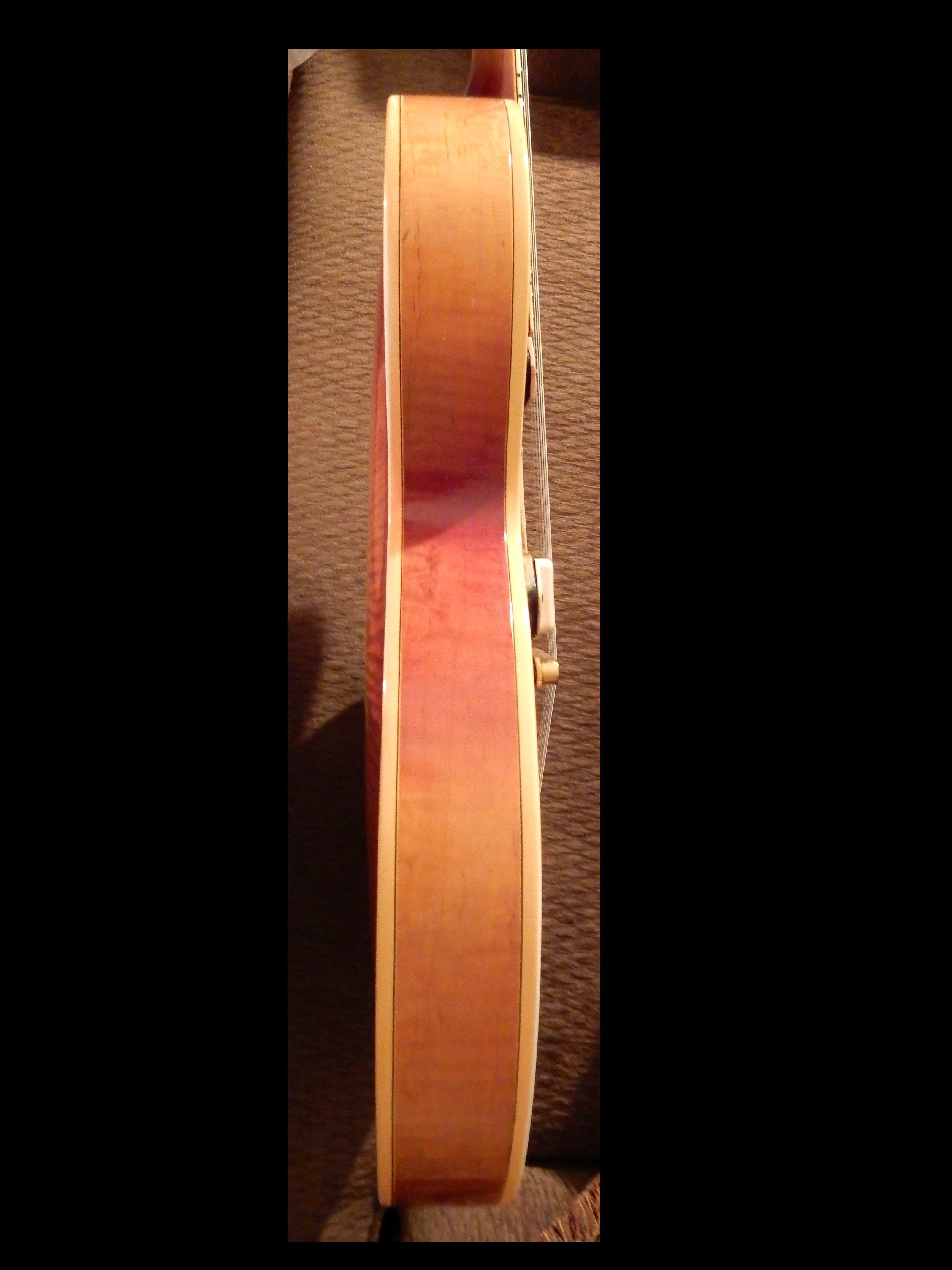
Designed with jazz players in mind, the Byrdland featured the same 17"
wide, 21" long spruce top body of the single cutaway L-5 CES, but with a shallower body, 2 1/4"
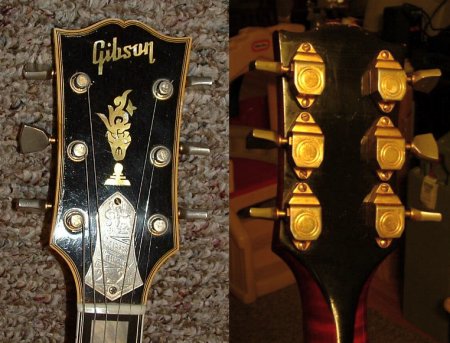
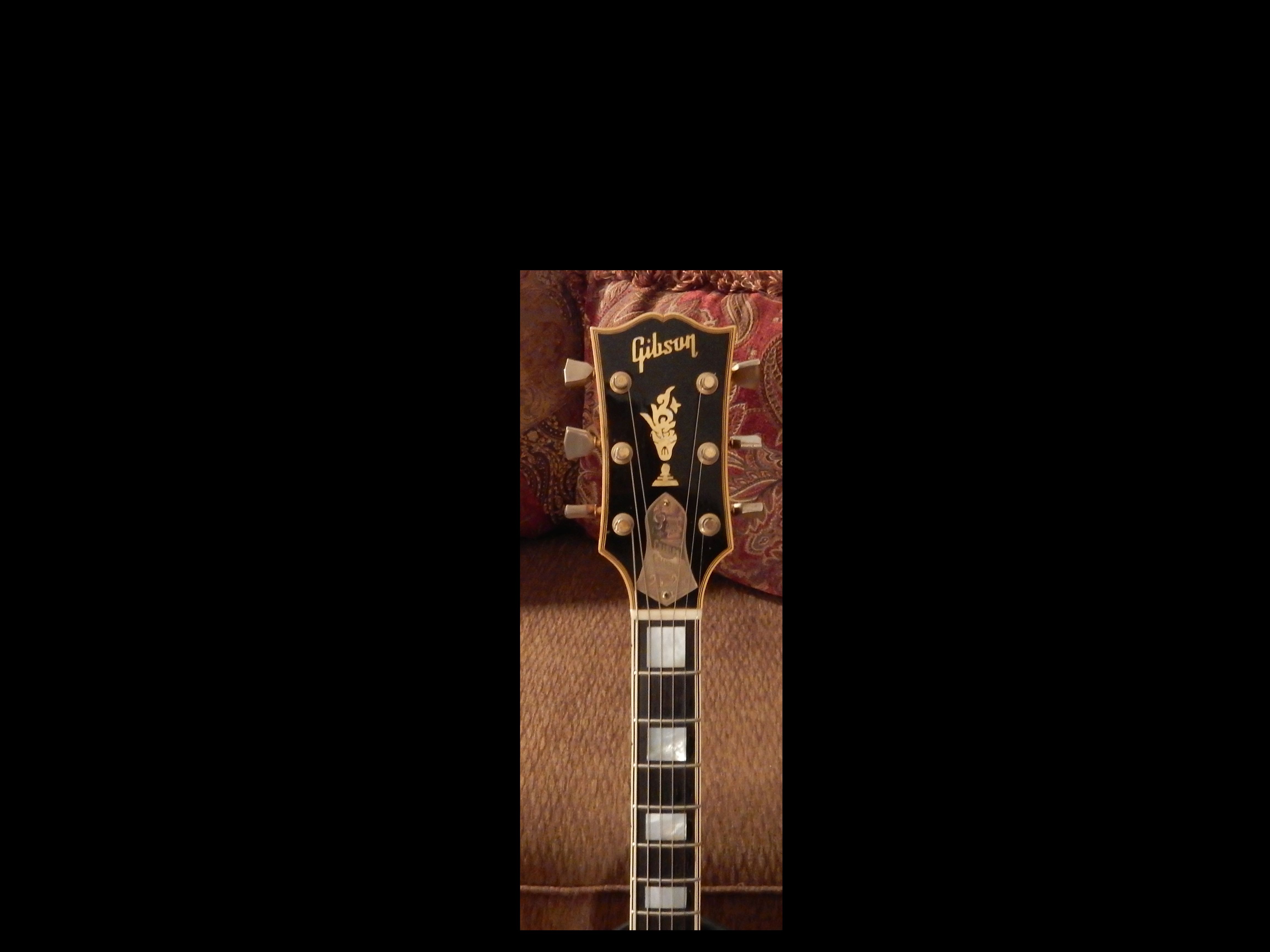
deep as opposed to the full 3 3/8 " of the L5. The headstock has the flower pot emblem like the
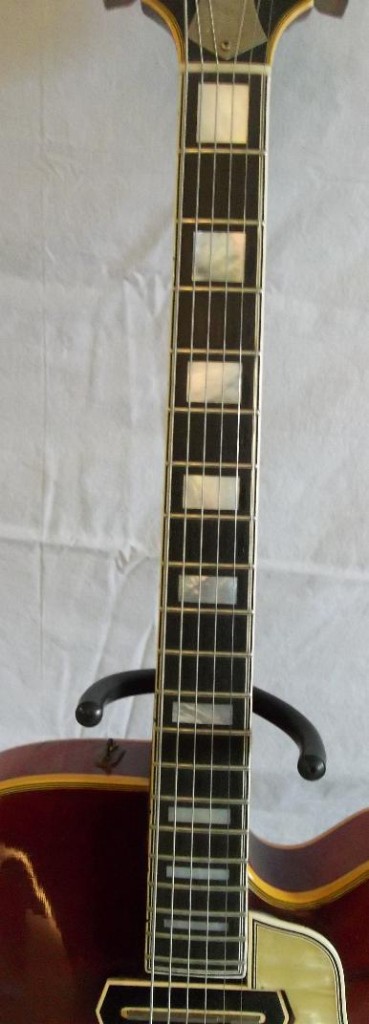
L-5 but has a narrower, 22 fret neck with a 23 1/2" scale length,
2" shorter than the L-5. Initially, production models were released equipped with the
Alnico V pickups introduced on most high end
Gibson models in 1954 but spaced closer together because of the shorter scale length, giving the Byrdland its distinctive sound. Humbuckers replaced the Alnico V pickups in 1957,
along with the rest of Gibson's line.
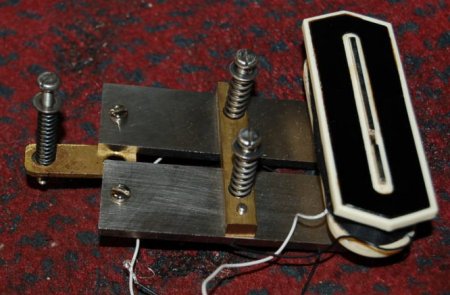
Gibson Charlie Christian (reissue) Pickup
Photo courtesy eBay
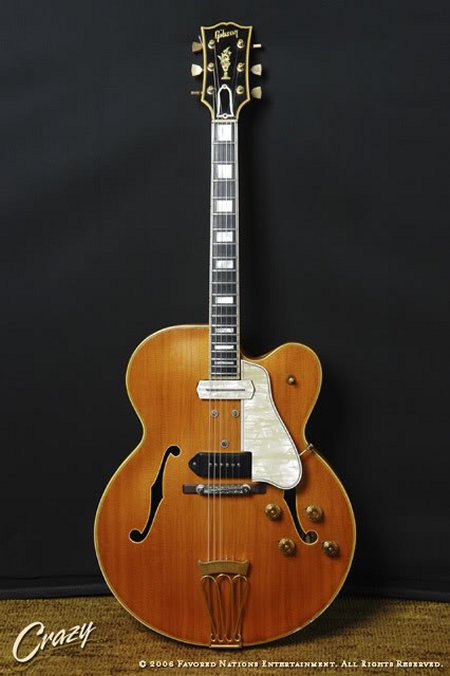
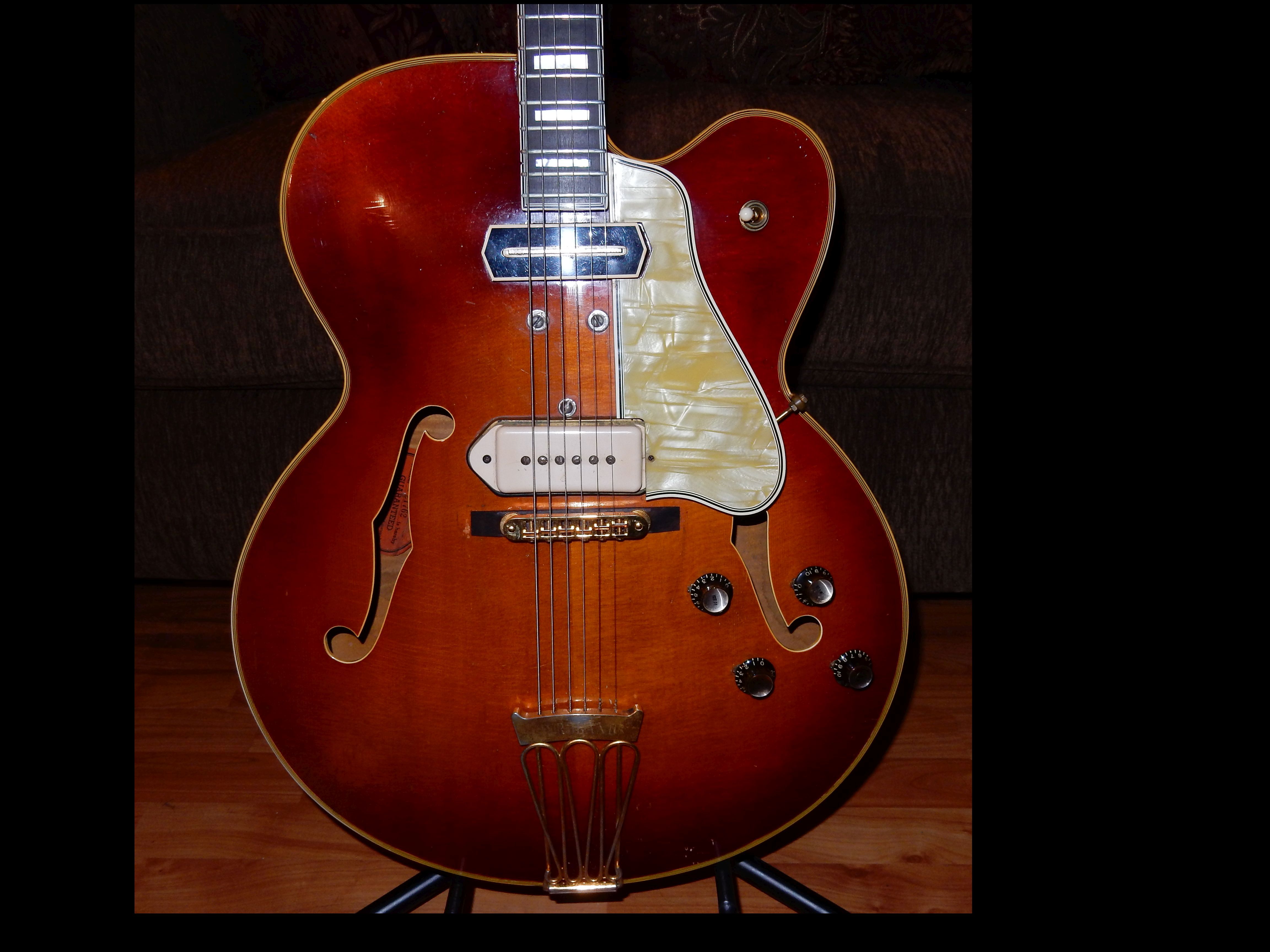
Hank's, and possibly Billy's guitars were custom ordered with a single
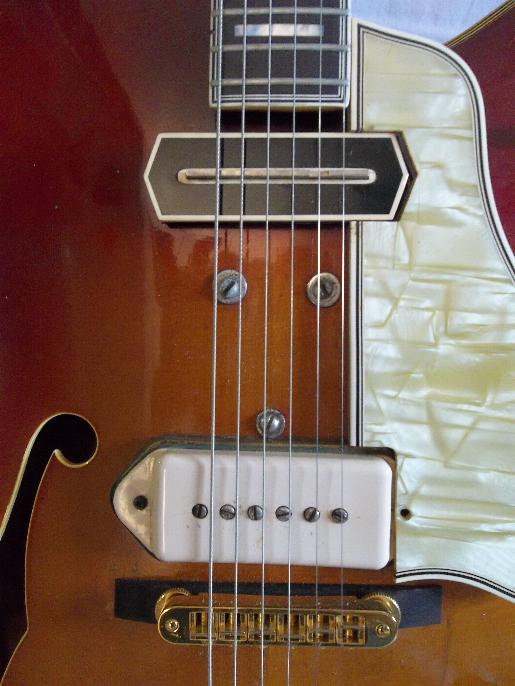
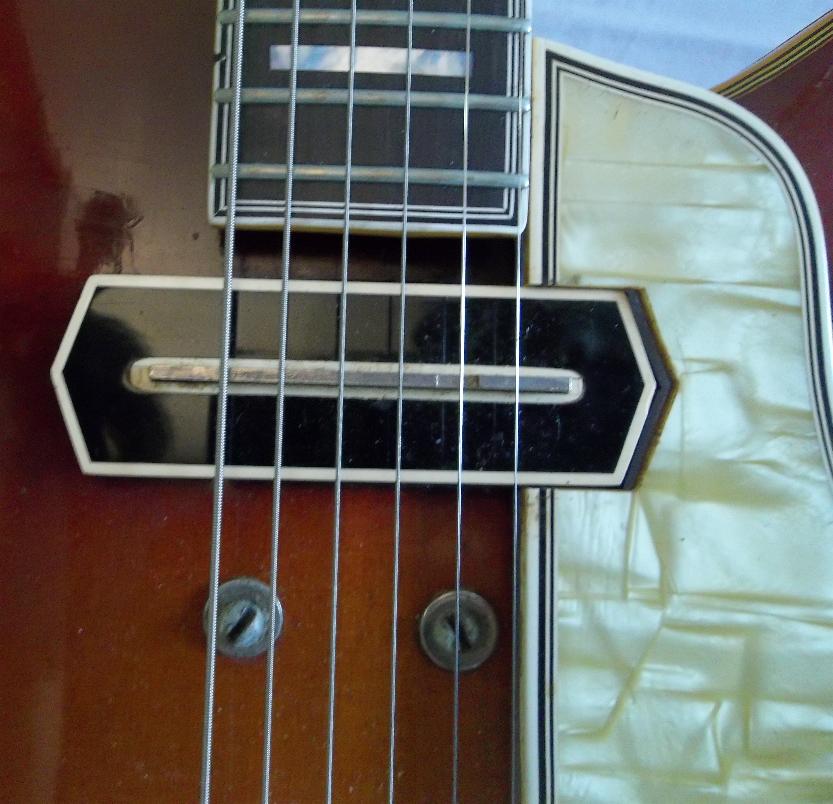
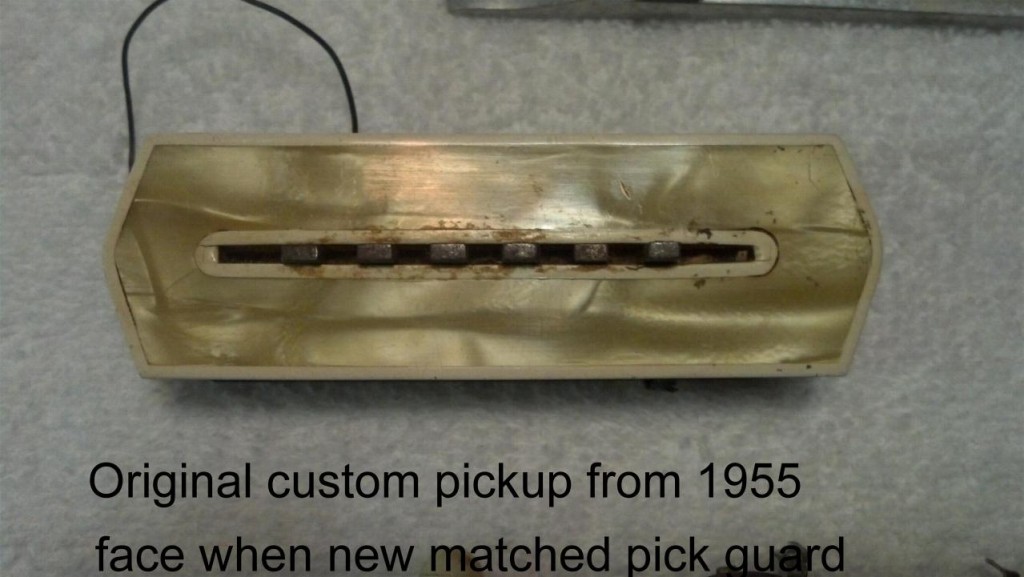
coil P90 pickup in the bridge position and like several of his other guitars, a Charlie Christian in the neck.
Their guitars because of the pickup had only 20 fret necks.
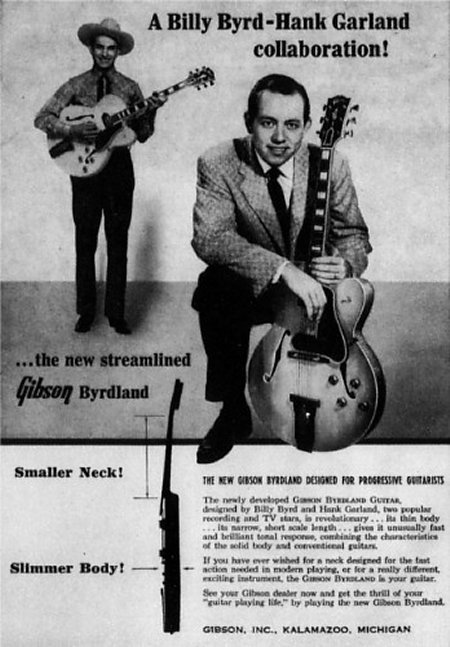
Gibson Byrdland advertisement
Photo courtesy web
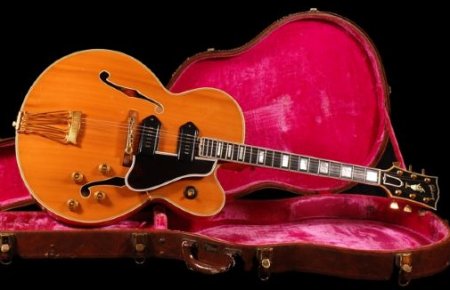
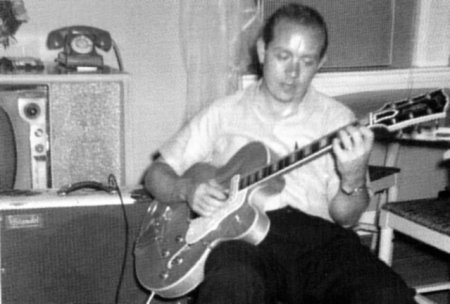
Though Hank is pictured in early advertisements with what appears to be his #2 Byrdland
N (natural finish), it features an L-5 tailpiece and a tortoise pickguard. His guitars when
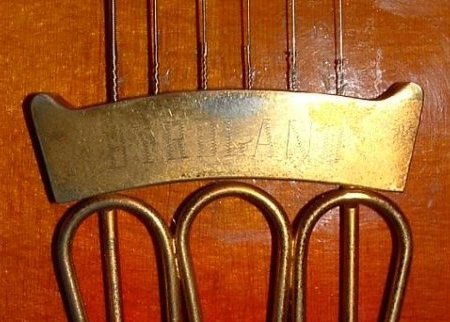
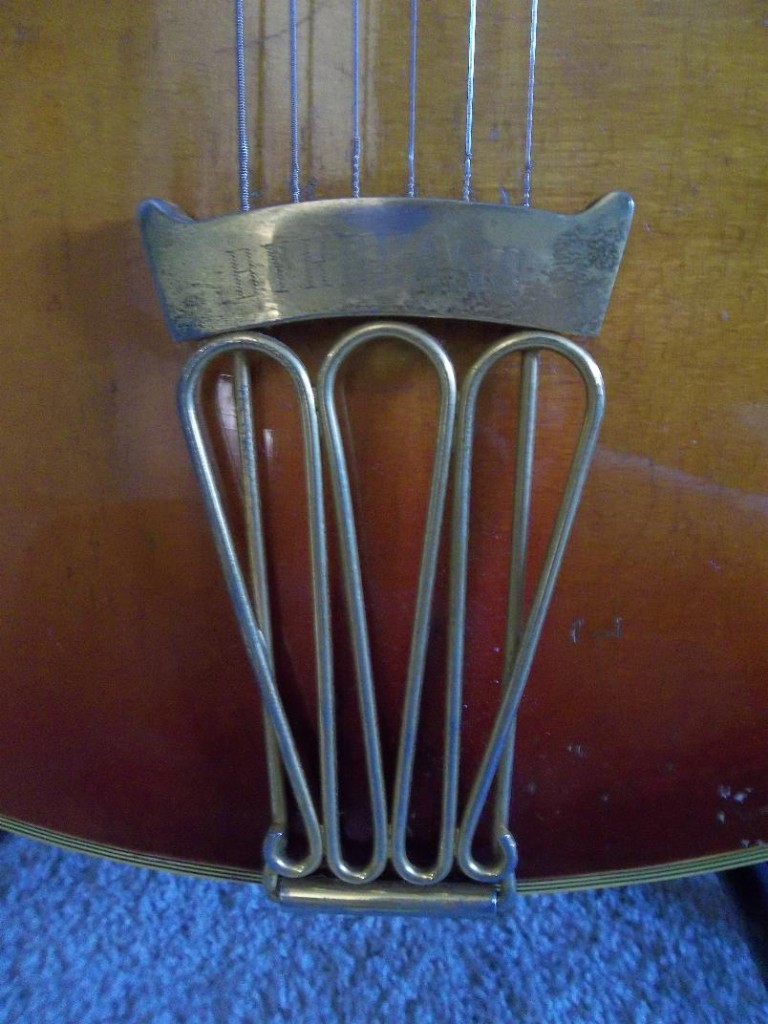
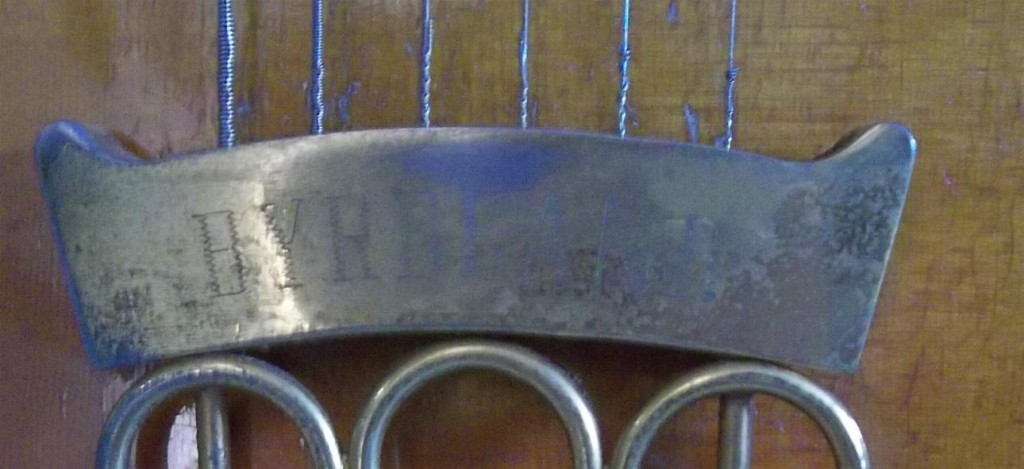
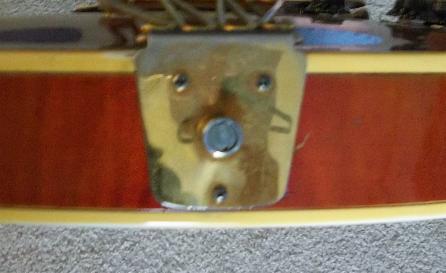
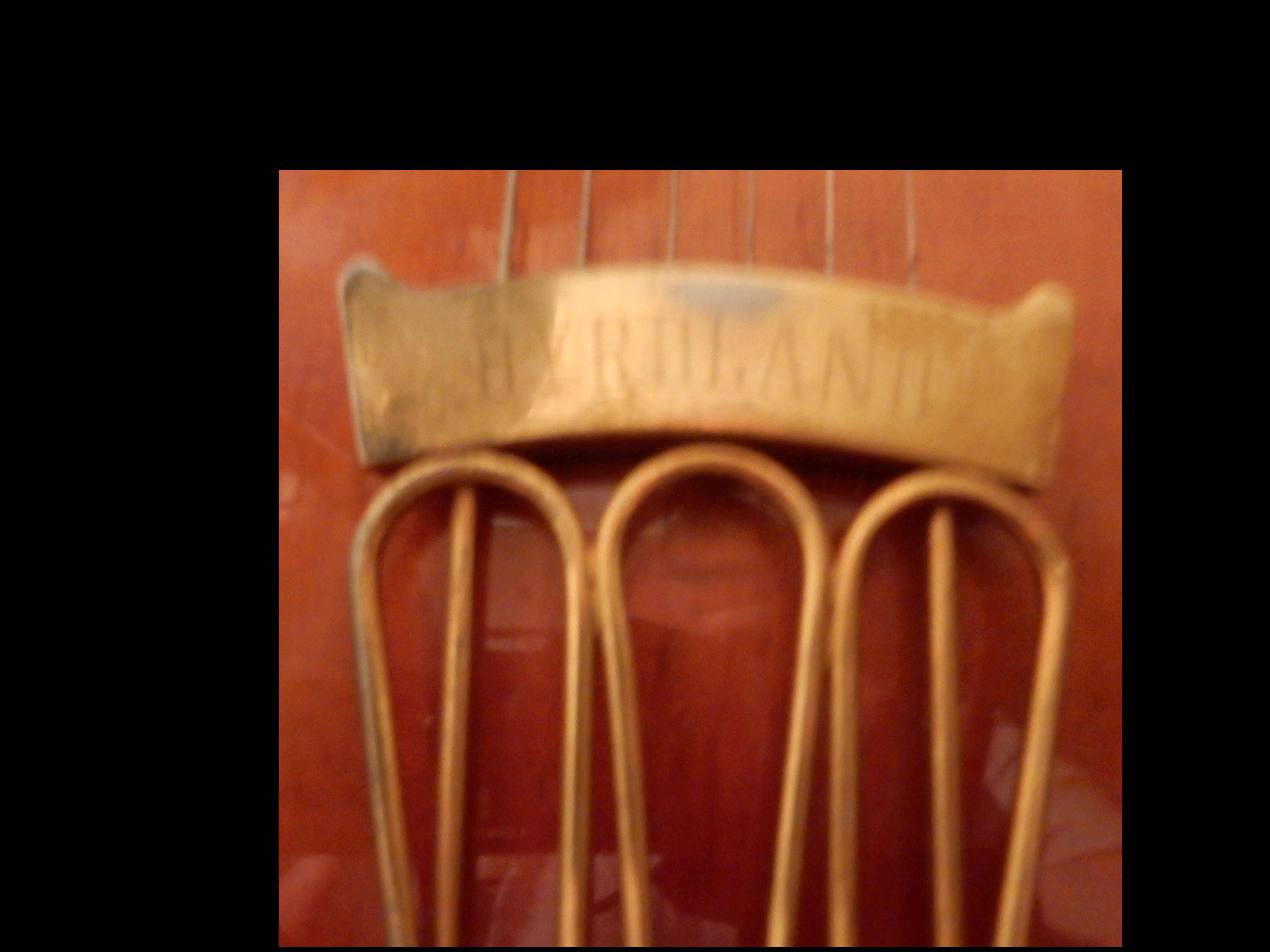
delivered would have the standard special designed three loop, gold-plated tailpiece engraved with BYRDLAND and a white perloid
pickguard.
Hank with his 1955 Gibson #2 Byrdland-N
Photo courtesy tdpri
In 1956, the following year, 60 units were sold, compared to 41 electric
Super 400s and 55 L-5CES models. Comparing prices, the Super 400CES listed in 1957 for $675.00 in sunburst, $700.00 in natural (blonde); the L-5CES was $600.00 in sunburst, $615.00 in natural. By 1957 the number of Byrdlands sold was nearly double the combined number of Super 400 and L-5 electrics sold.
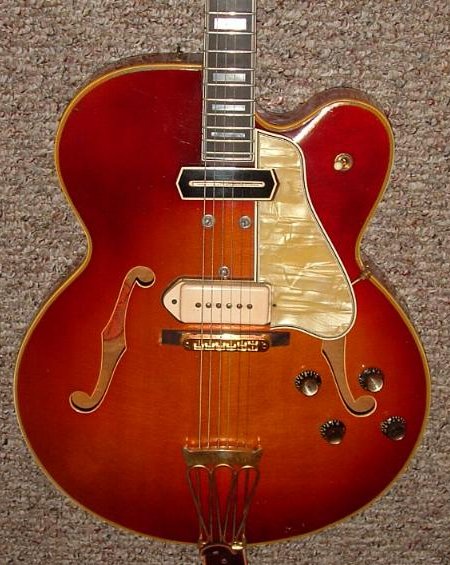
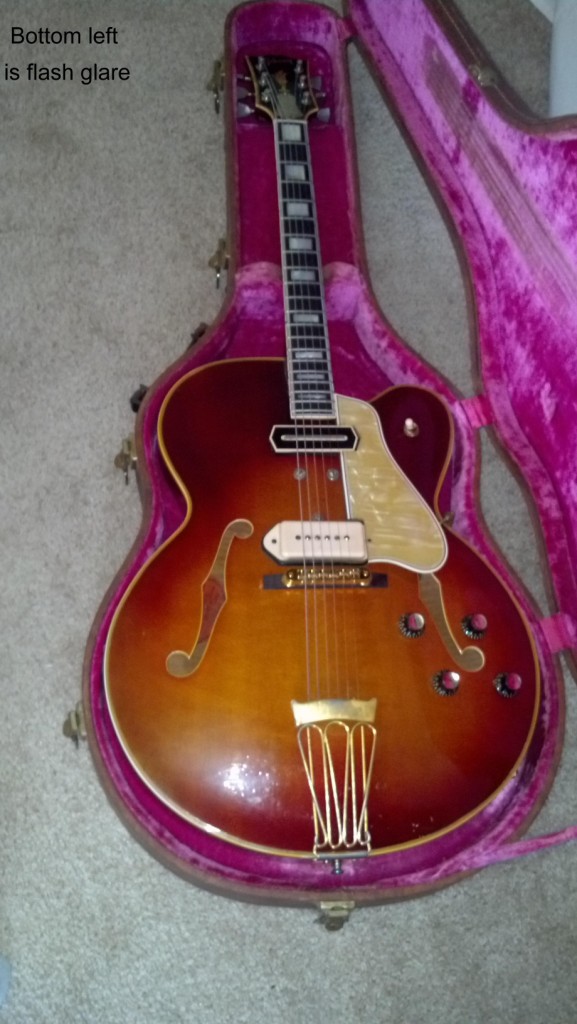
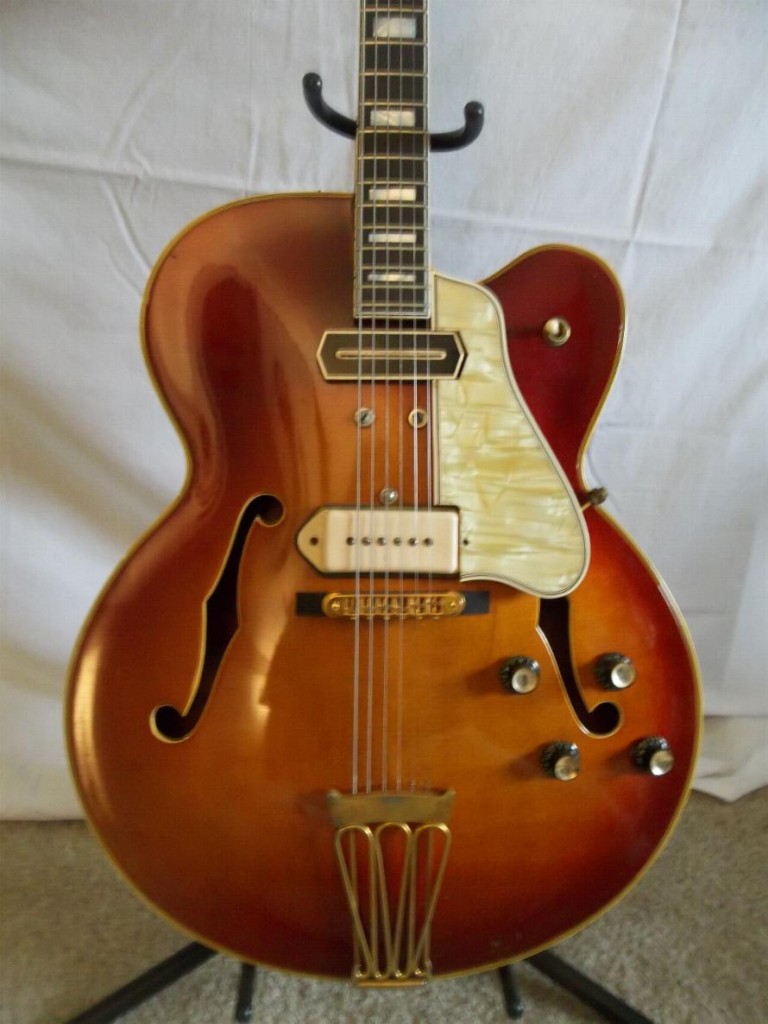
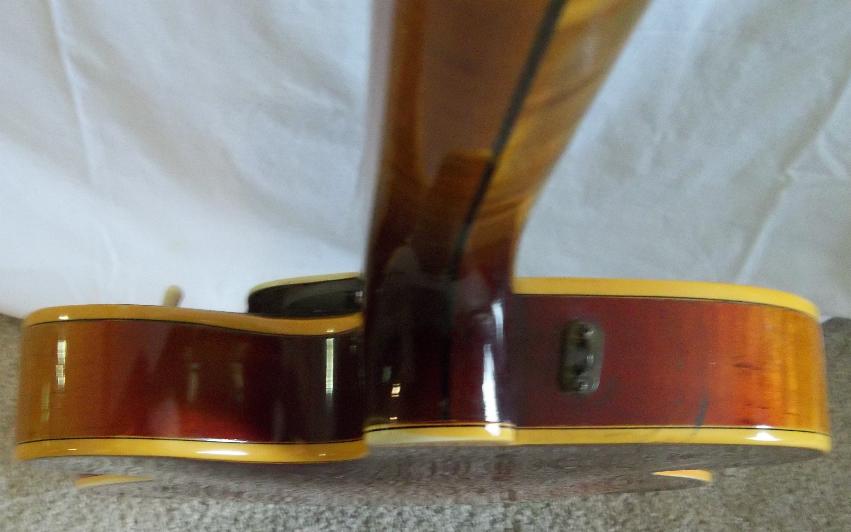
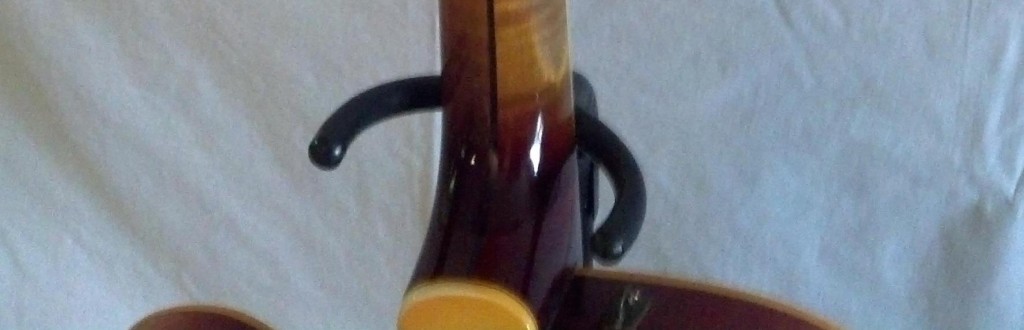
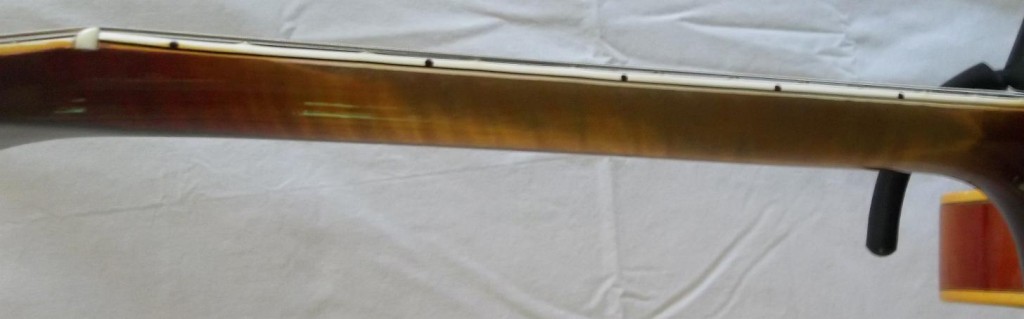
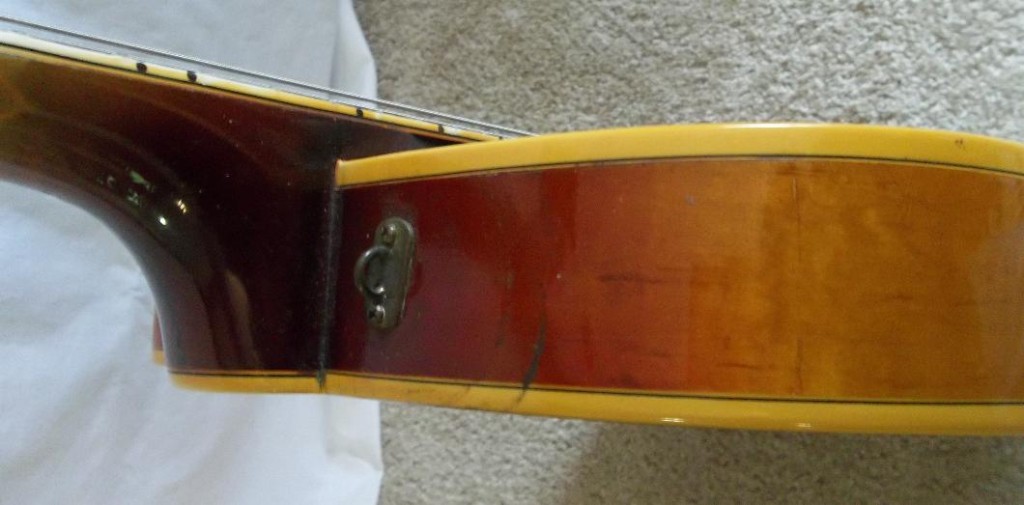
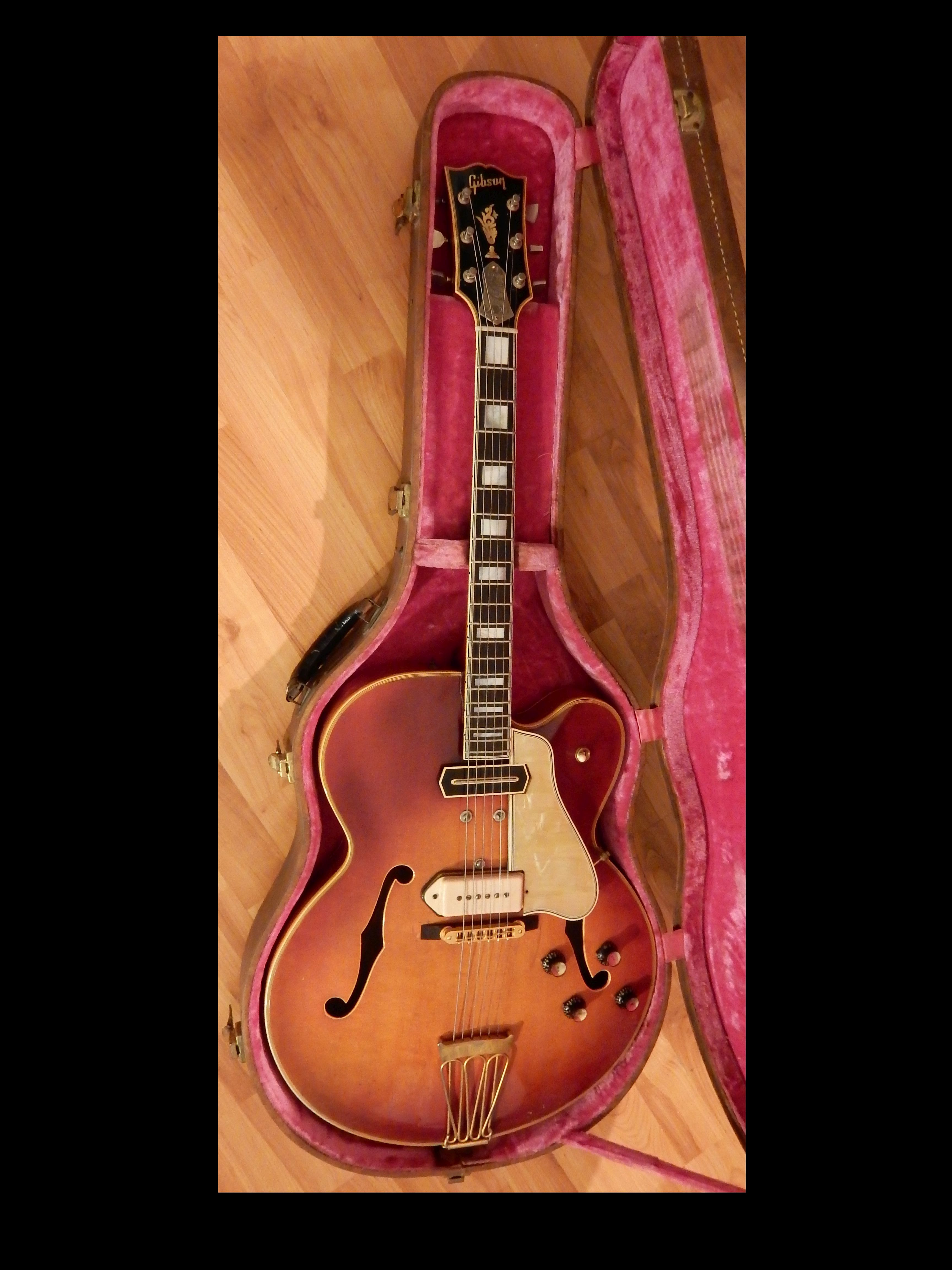
1955 #3 Gibson Byrdland
Photo courtesy Allen Arnold
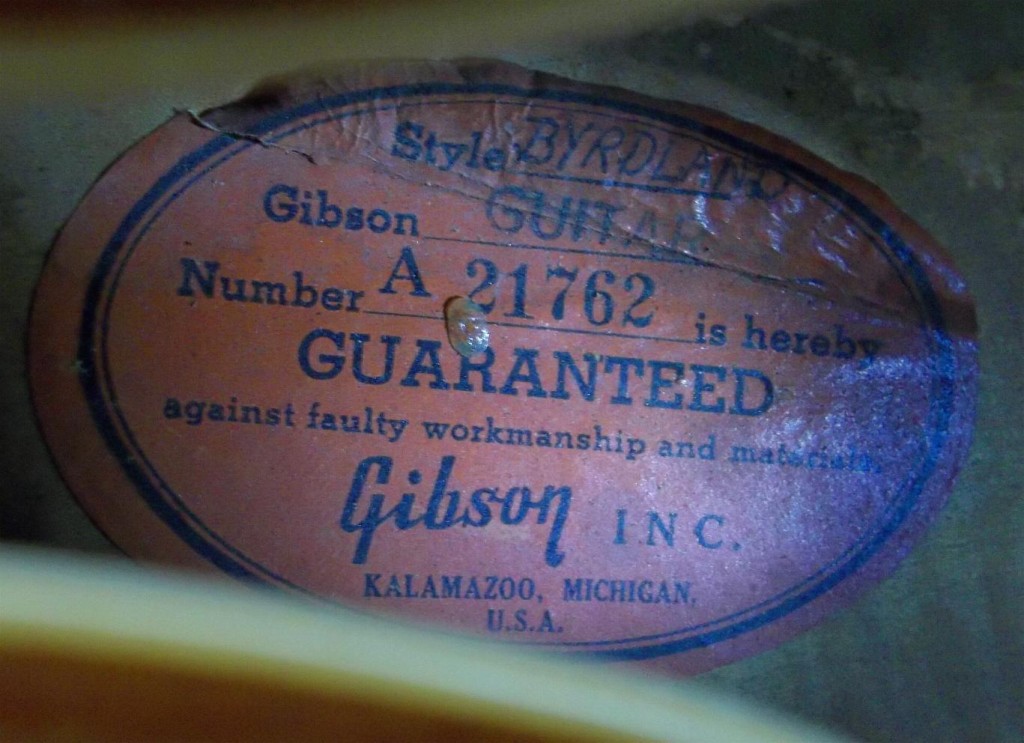
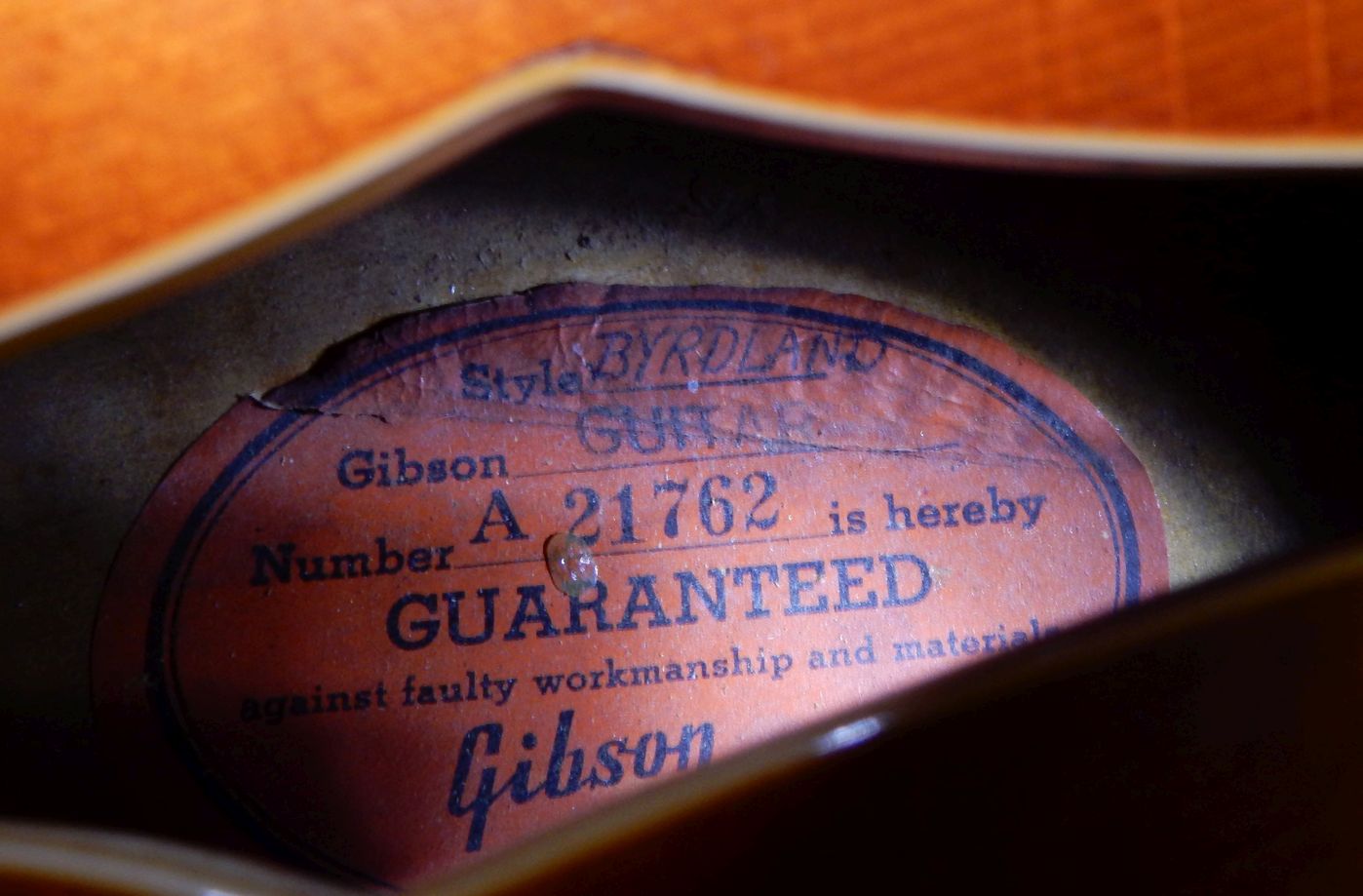
Allen Arnold, who is brokering this guitar said to be Hank's #3 Byrdland, contacted Gibson about the serial number (A217XX) and was told that
they don't have records of
ownership only manufacture, but it was order number "3" in 1955. He
said that when Hank custom ordered the #3, Gibson was reluctant to build it thinking no one would buy a cherry sunburst Byrdland.
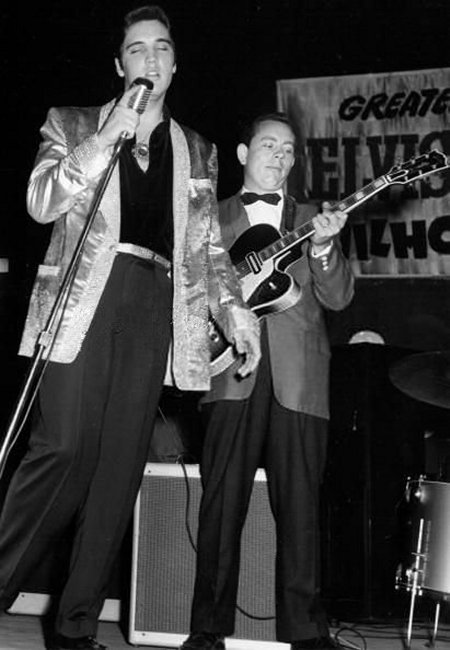
This is quite likely the guitar played by Hank with Elvis when they performed in Tupelo,
MS on September 27, 1957 during the period when Scotty and Bill had left the band, though at the time the guitar
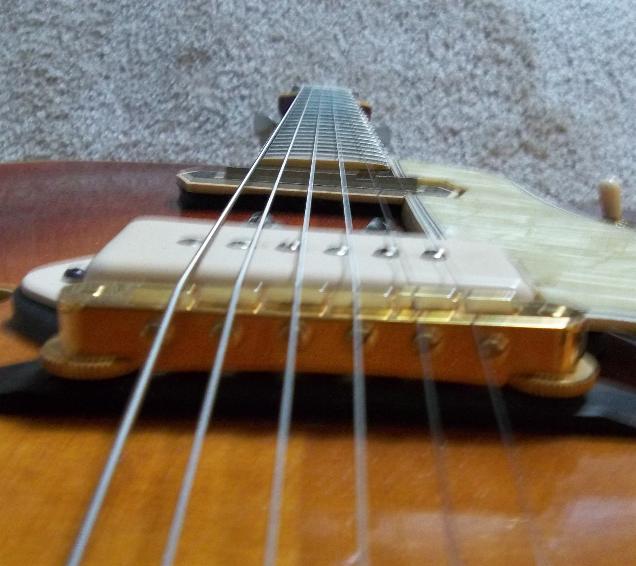
had a black P90 in the bridge position, not the current cream colored one.
Charlie Chambers with 1955 #3 Gibson Byrdland
Photo courtesy Allen Arnold
According to Allen, Hank owned it until 1957 when Gibson took it back to put it in their archives but
accidentally delivered it to Allen Music in Chattanooga for store stock.
Charlie
Chambers, a former Nashville sessions player in the 1950's and 60's and a teacher at Allen Music bought the guitar.
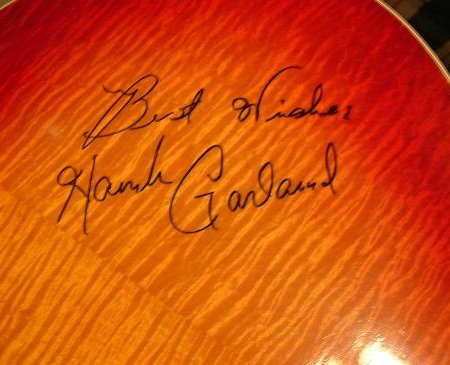
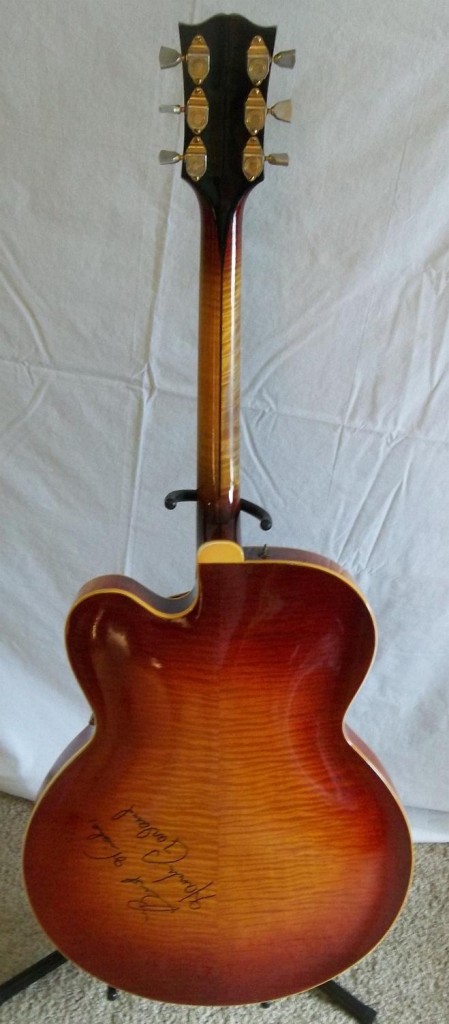
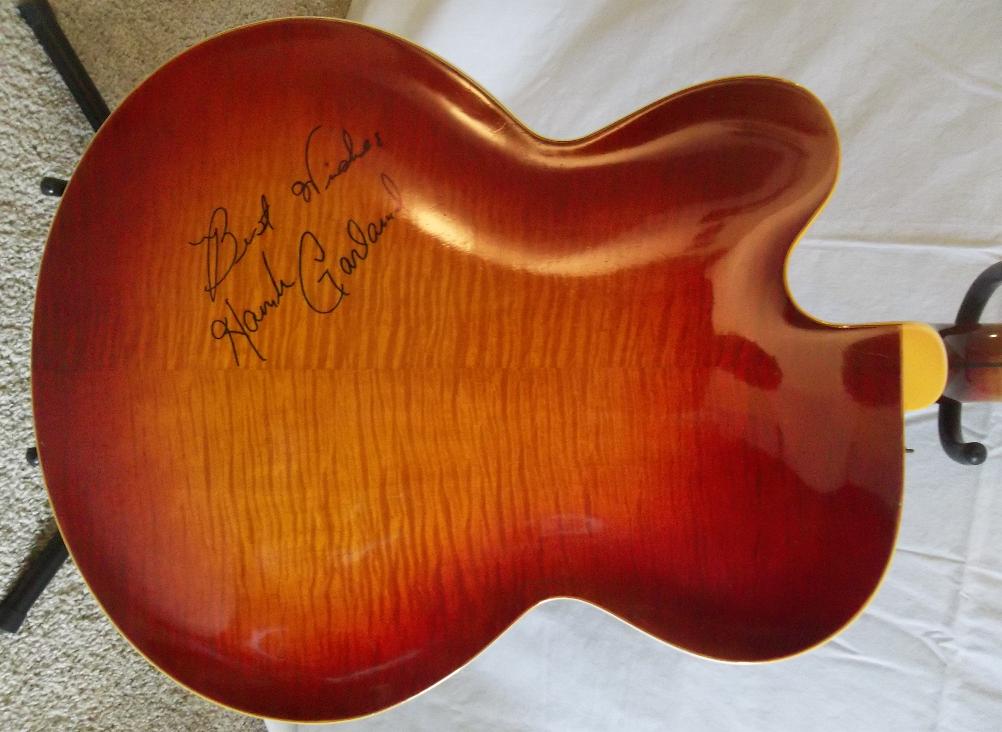
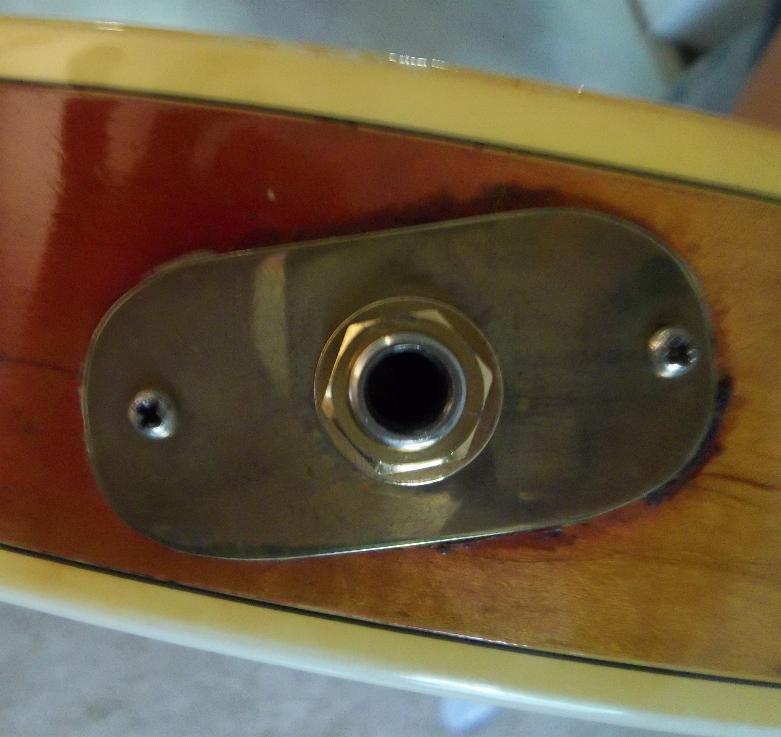
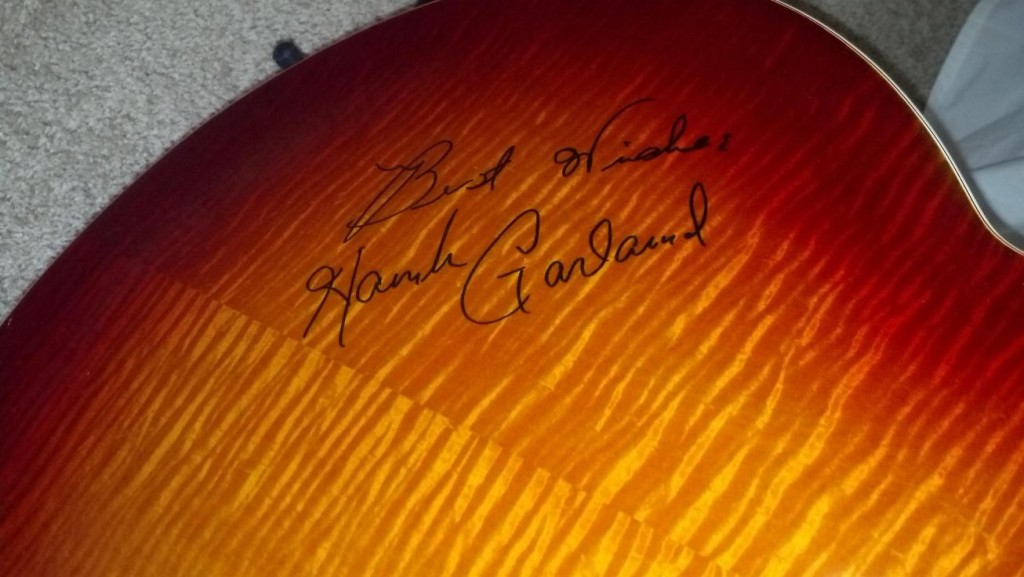
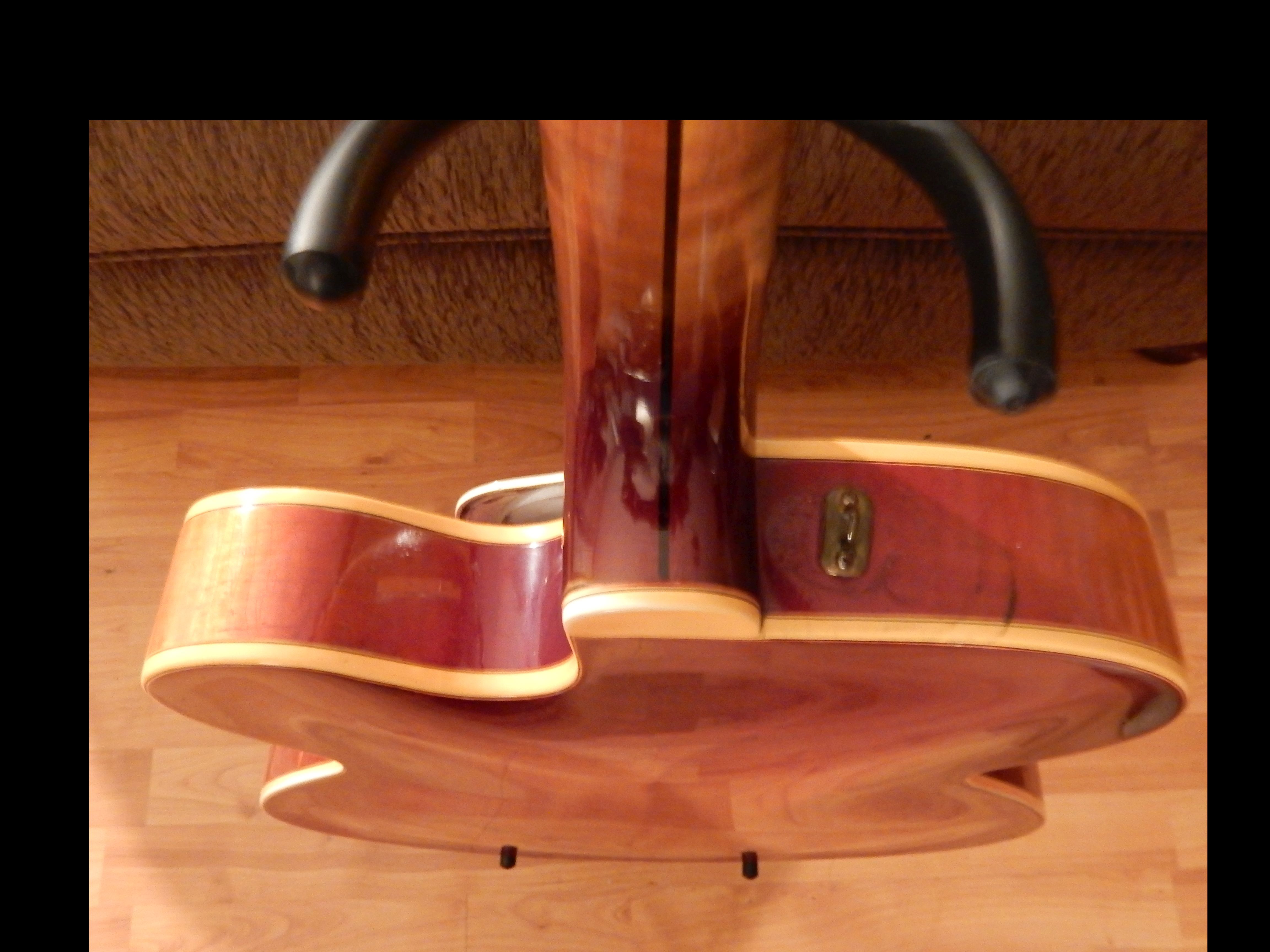
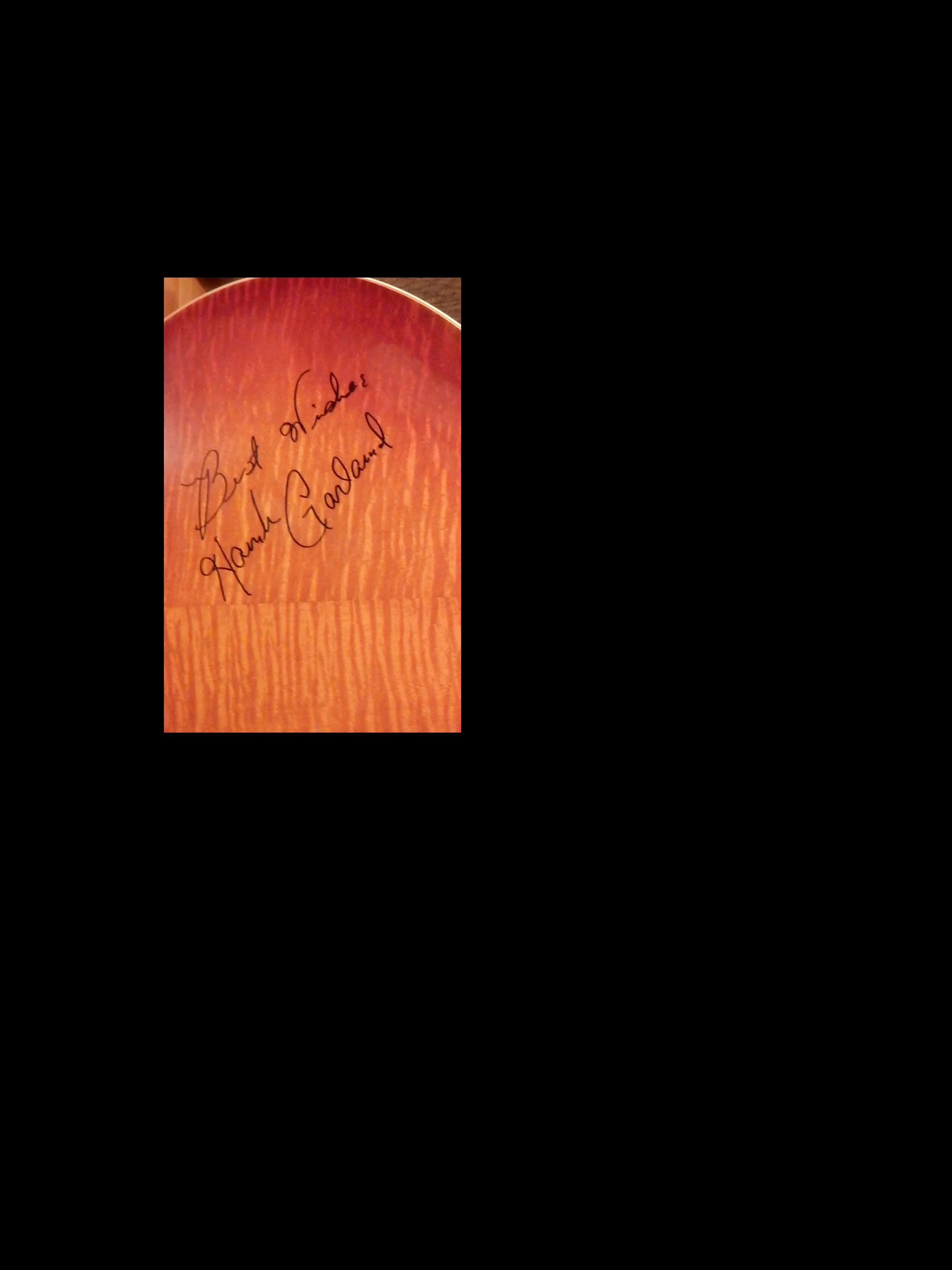
rear of 1955 #3 Gibson Byrdland signed by Hank Garland
Photo courtesy Allen Arnold
When Gibson realized the mistake they were unsuccessful at getting it back from Charlie, who went straight to the sessions with the guitar. Hank saw the case, asked him how he got that guitar and Charlie told him. Hank said,
"Well you bought it, so it's yours," signed the back of it and told him the history of the guitar.*
tailpiece on 1955 #3 Gibson Byrdland believed to have
been Hank Garland's
Photo courtesy Allen Arnold
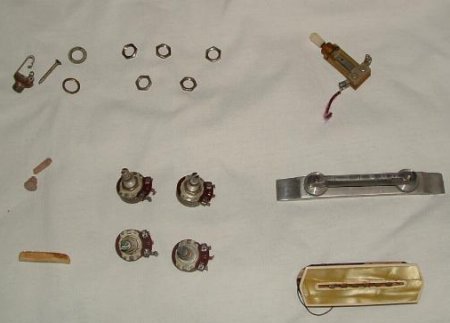
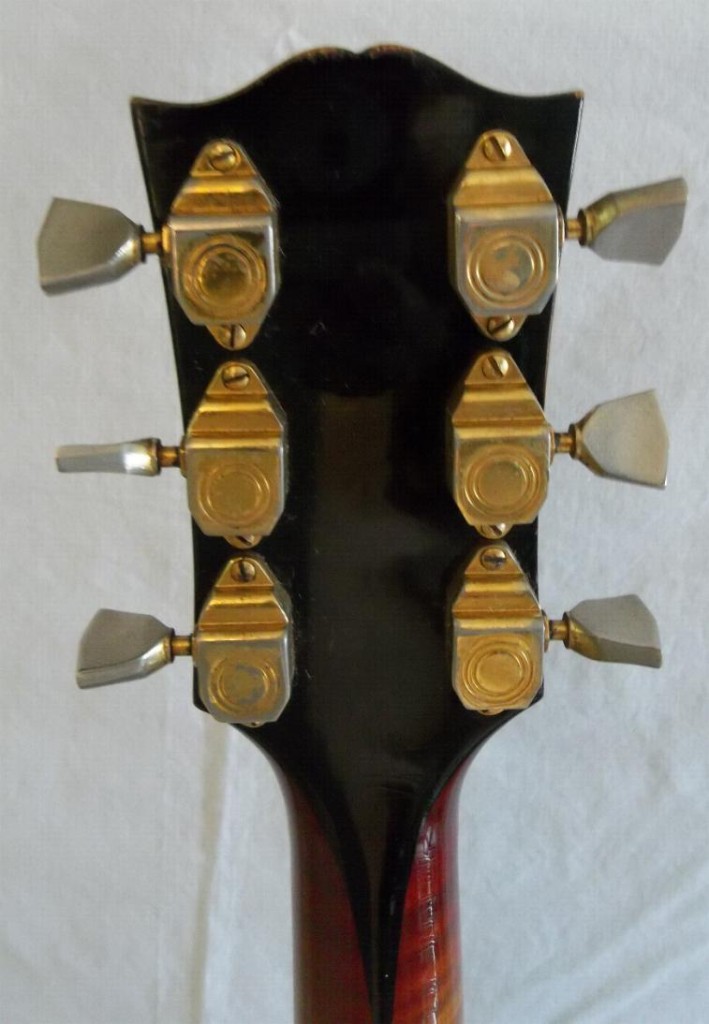
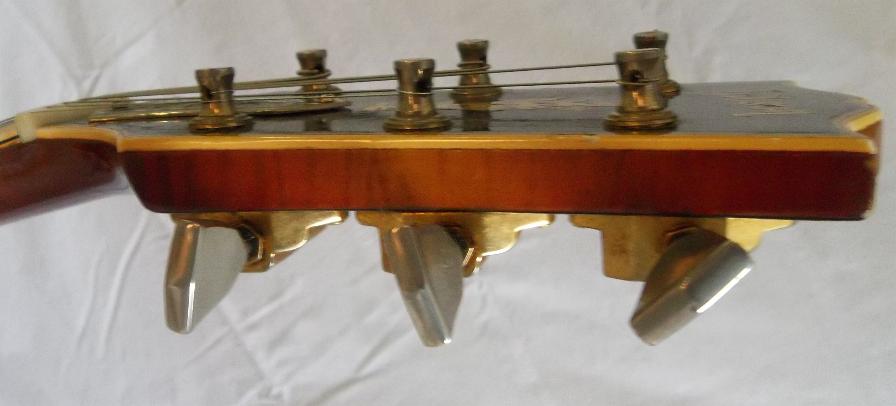
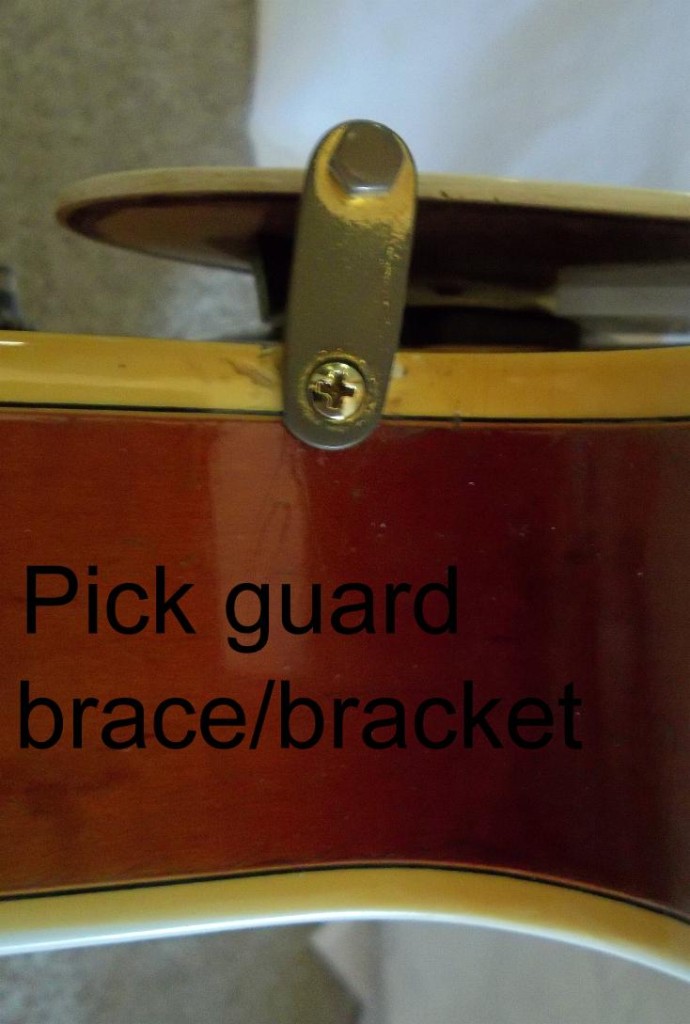
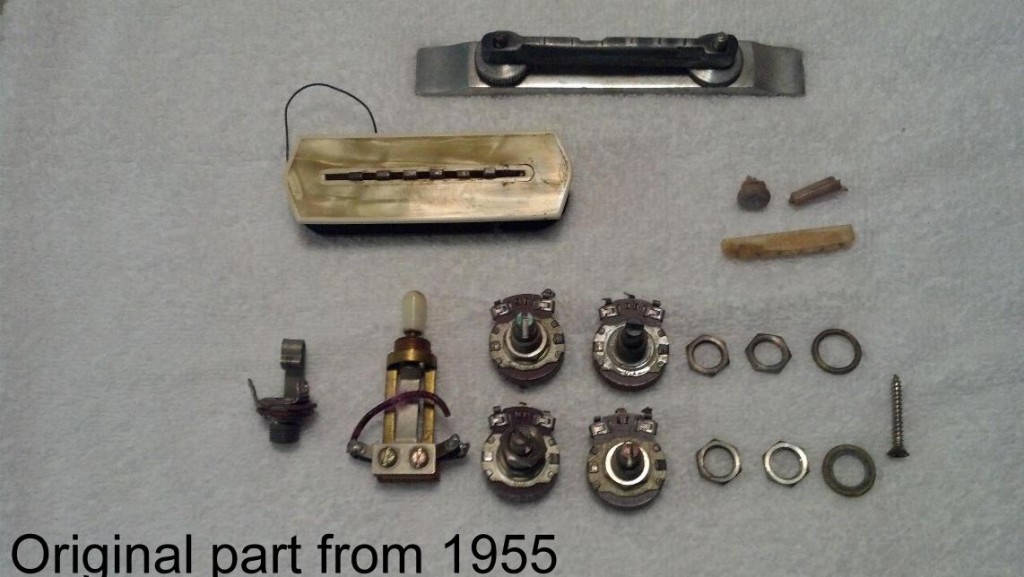
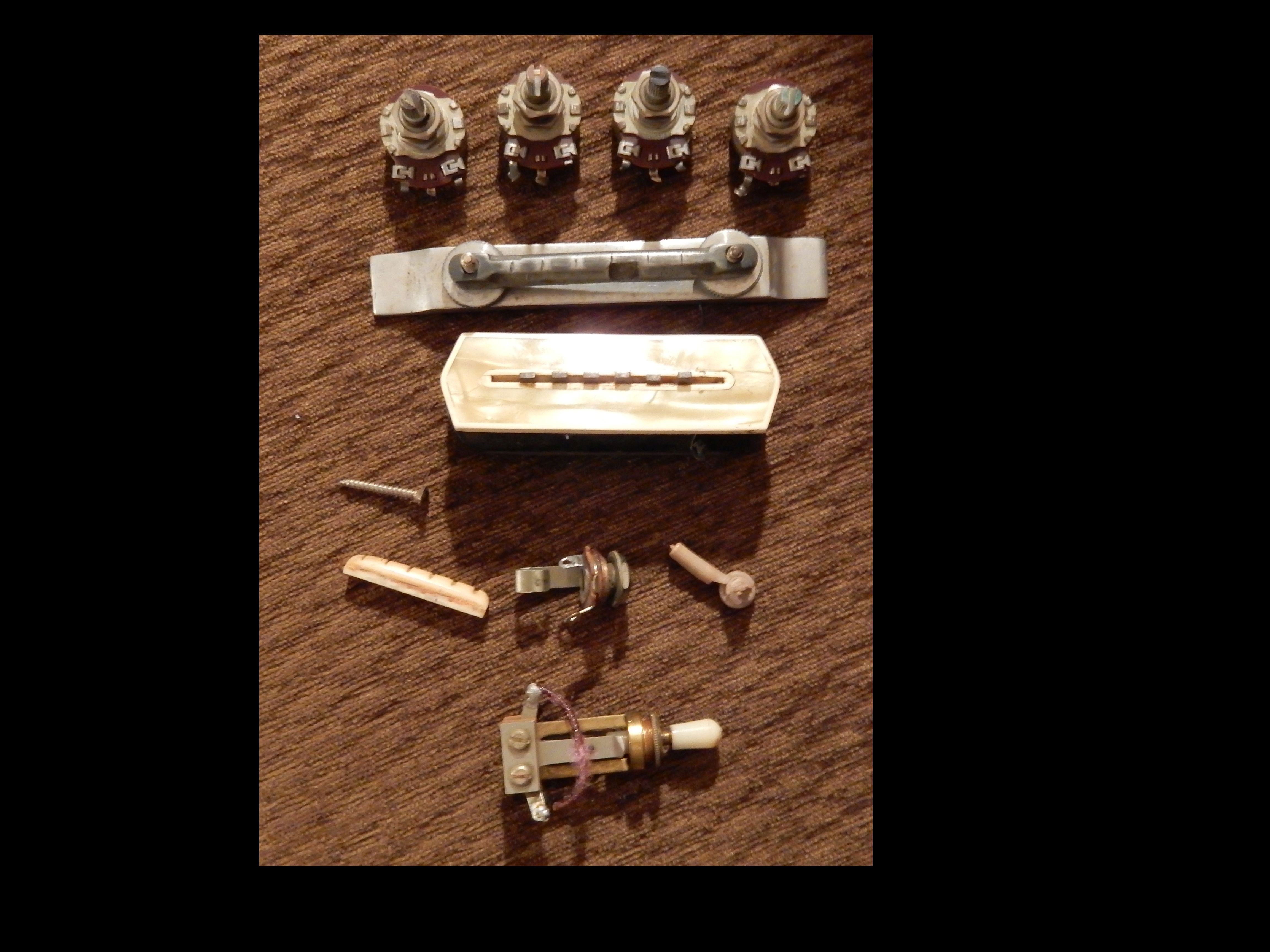
original parts from 1955 #3 Gibson Byrdland
Photo courtesy Allen Arnold
The guitar has been in Charlie's family since. Charlie changed several parts on the guitar but kept most of the original parts except the truss rod cover.
Charlie lost the guitar to his ex-wife 30 years ago. It has stayed untouched
except for times his ex-wife let him record with it though now they have plans to put it up for auction.
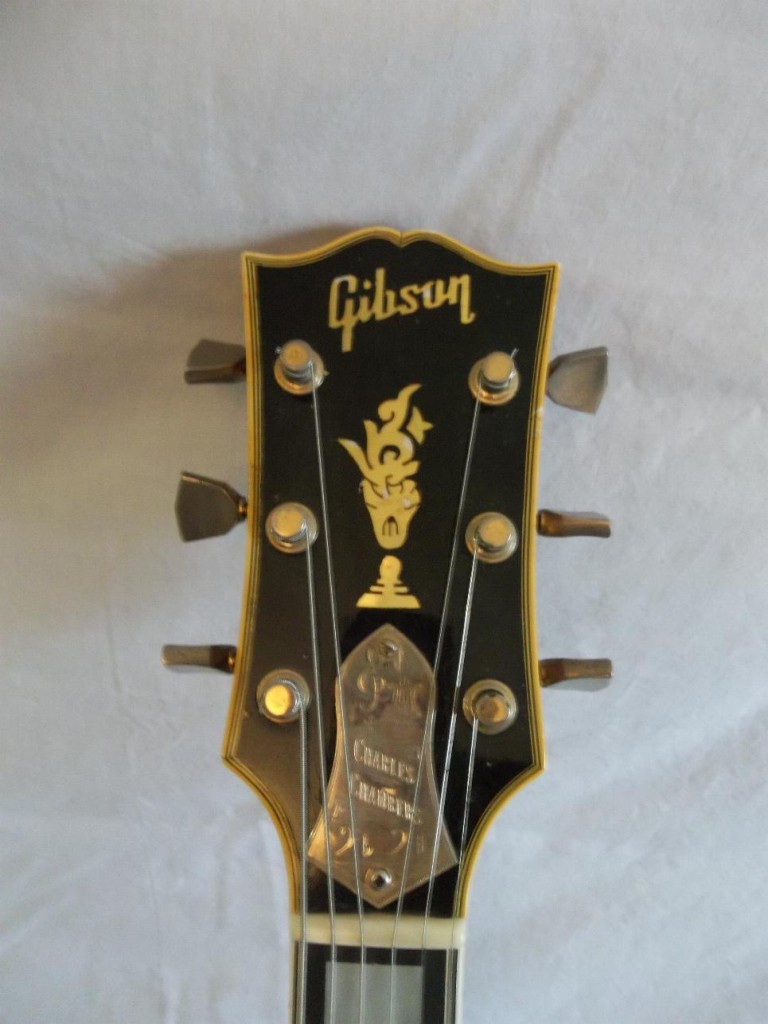
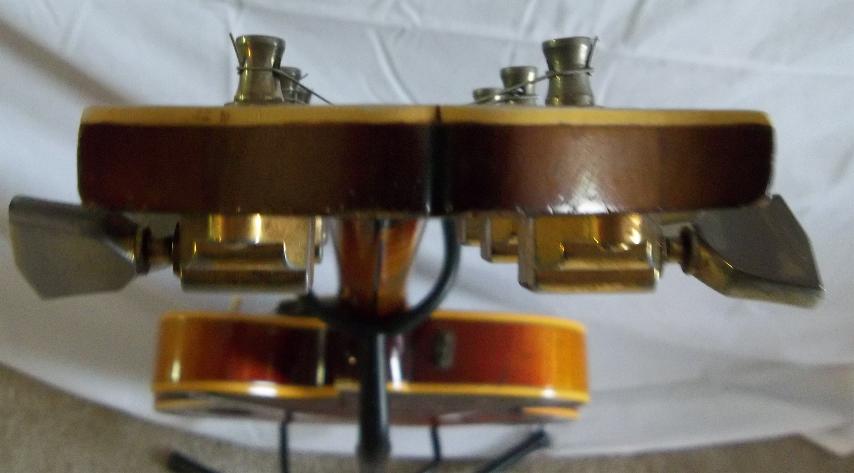
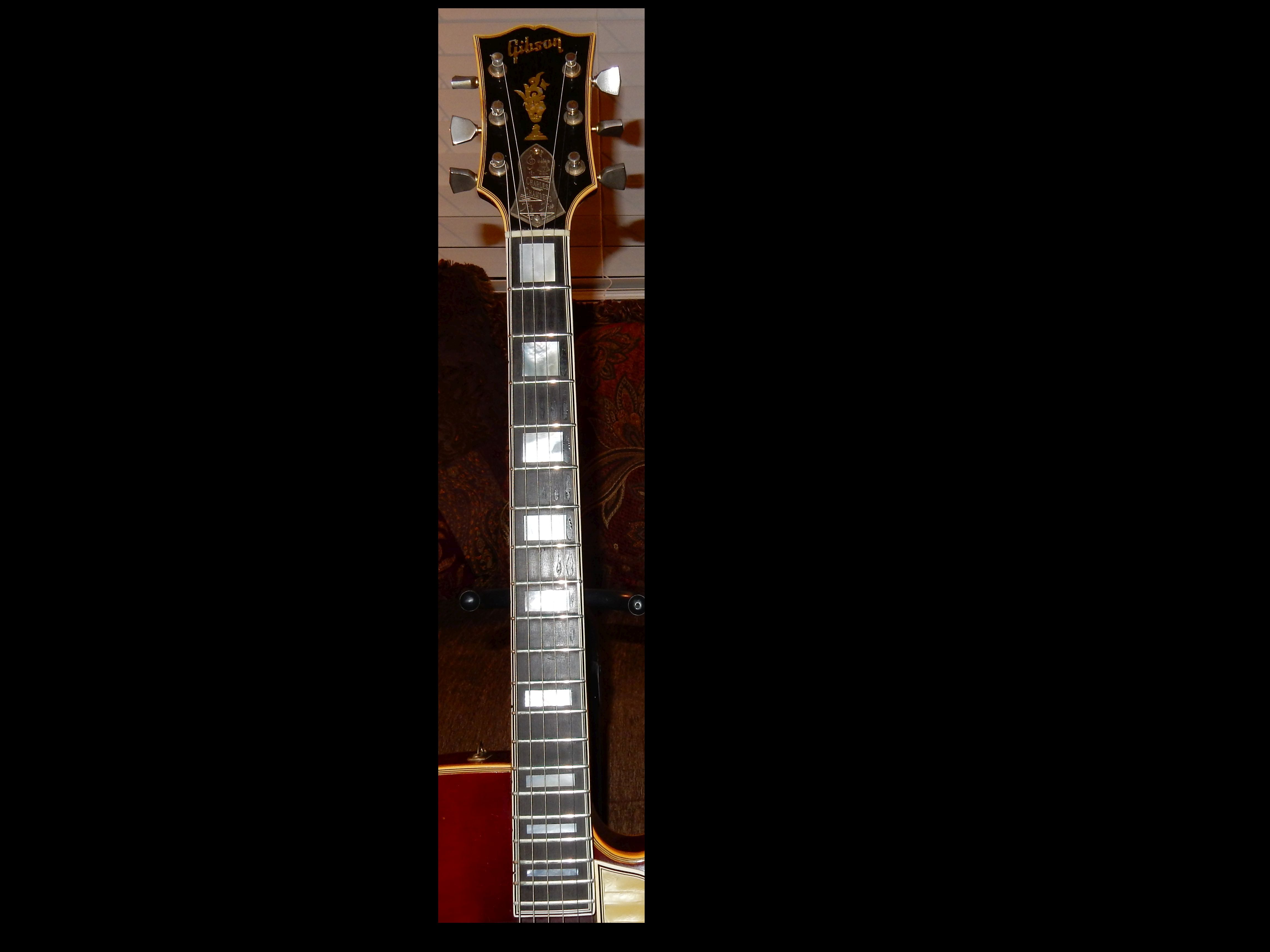
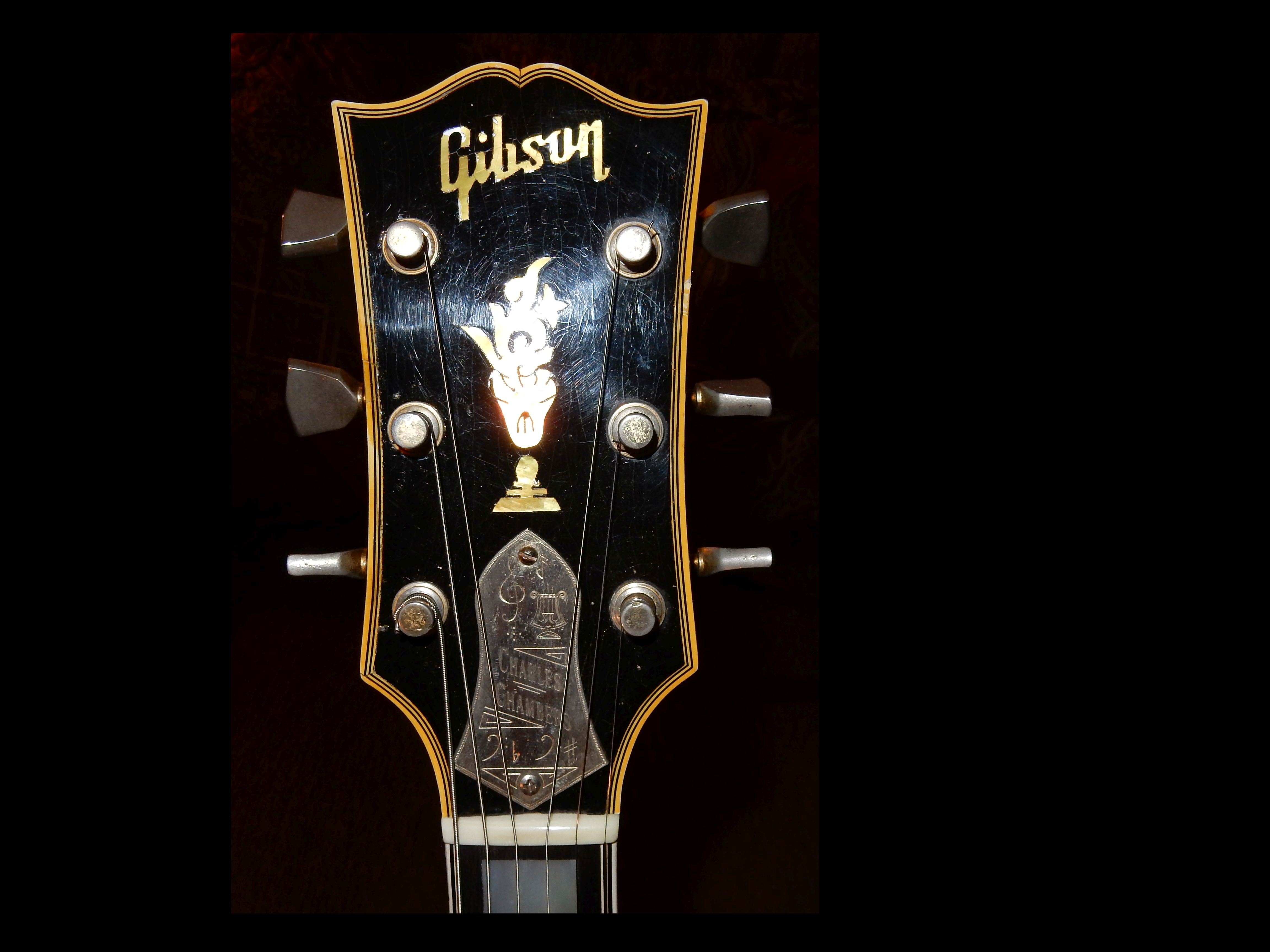
headstock of 1955 #3 Gibson Byrdland believed to have
been Hank Garland's
Photo courtesy Allen Arnold
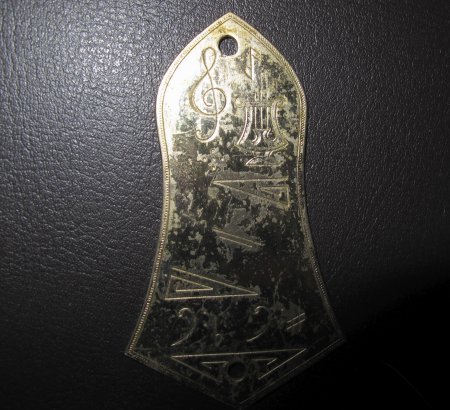
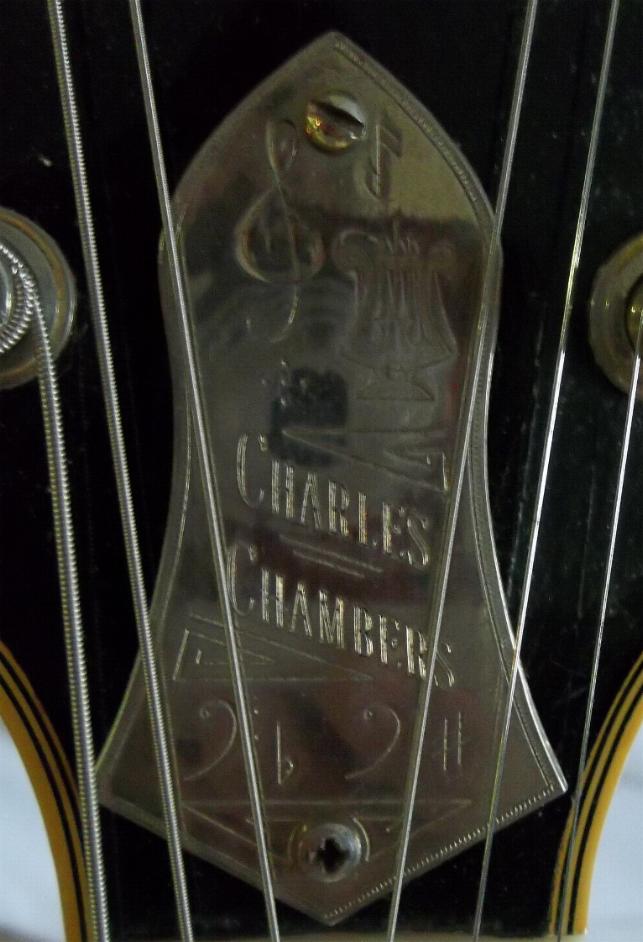
Oddly enough, the guitar has a unique personalized metal truss cover almost identical to
one on the Gibson SG used by Elvis in Easy Come, Easy
Go except Charlie had his name on his.
custom truss cover like Charlie's, and the movie SG from the
Gibson banjo - Feb 5, 2011
Photo courtesy Trevor Rice
The truss cover appears to have been an aftermarket accessory and has since
showed up on three guitars, one, though not stock, on a '50s Gibson banjo.
page added August 30, 2010
Please note that neither I nor Scotty Moore have anything to do with the sale of this guitar and though we've no reason to suspect its
authenticity we can in no way attest to it. If and when we have further information or particulars about its sale
we will post it.
All info on the specific history of this #3 Byrdland is courtesy of and
according to Allen Arnold. The history and specifications of the Gibson
Byrdland guitar in general is courtesy Gibson
and George
Gruhn.
* Hank Garland was Charlie's idol since he was nine
years old. At eighteen Charlie was a B sessions player in Nashville
when he bought the guitar. In 1997 he attended a big party for Hank and
brought the guitar. Hank smiled, said he remembered the guitar
and signed it then.
Hank Garland was Charlie Chambers idol. When Charlie was nine
years old (1945) he went to the Ritz Theater to hear Hank Garland play
(Hank was 15). Once he heard Hank play he decided "I'm gonna play
like Hank", from that point on Charlie did everything he could to
"play like Hank".
At 18 years old Charlie was a "B" sessions player in
Nashville, Hank was on the "A" list sessions player. Every
chance Charlie got he would try to watch and hear Hank play. Charlie was
also a guitar teacher at Allen Music in Chattanooga TN.
In 1955 Billy Byrd and Hank Garland designed the Byrdland for
Gibson, Billy Byrd received the first Byrdland Guitar in 1955 (#1), Hank
Garland got the (#2) Byrdland in 1955 ( a honey/natural finish). Hank
contacted Gibson and put in a order for a completely custom #3 guitar,
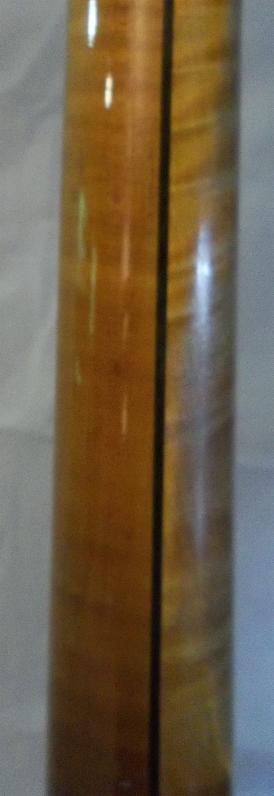
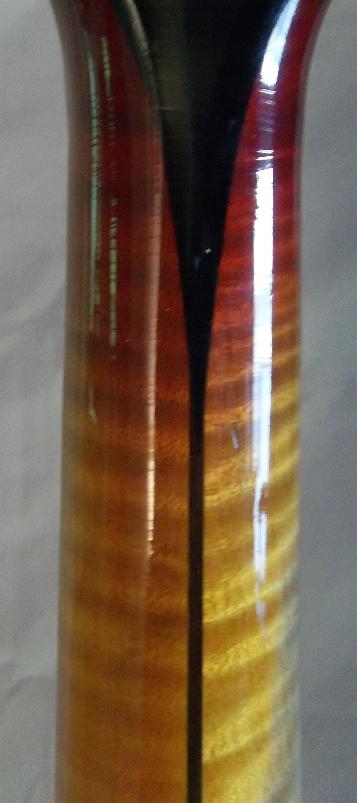
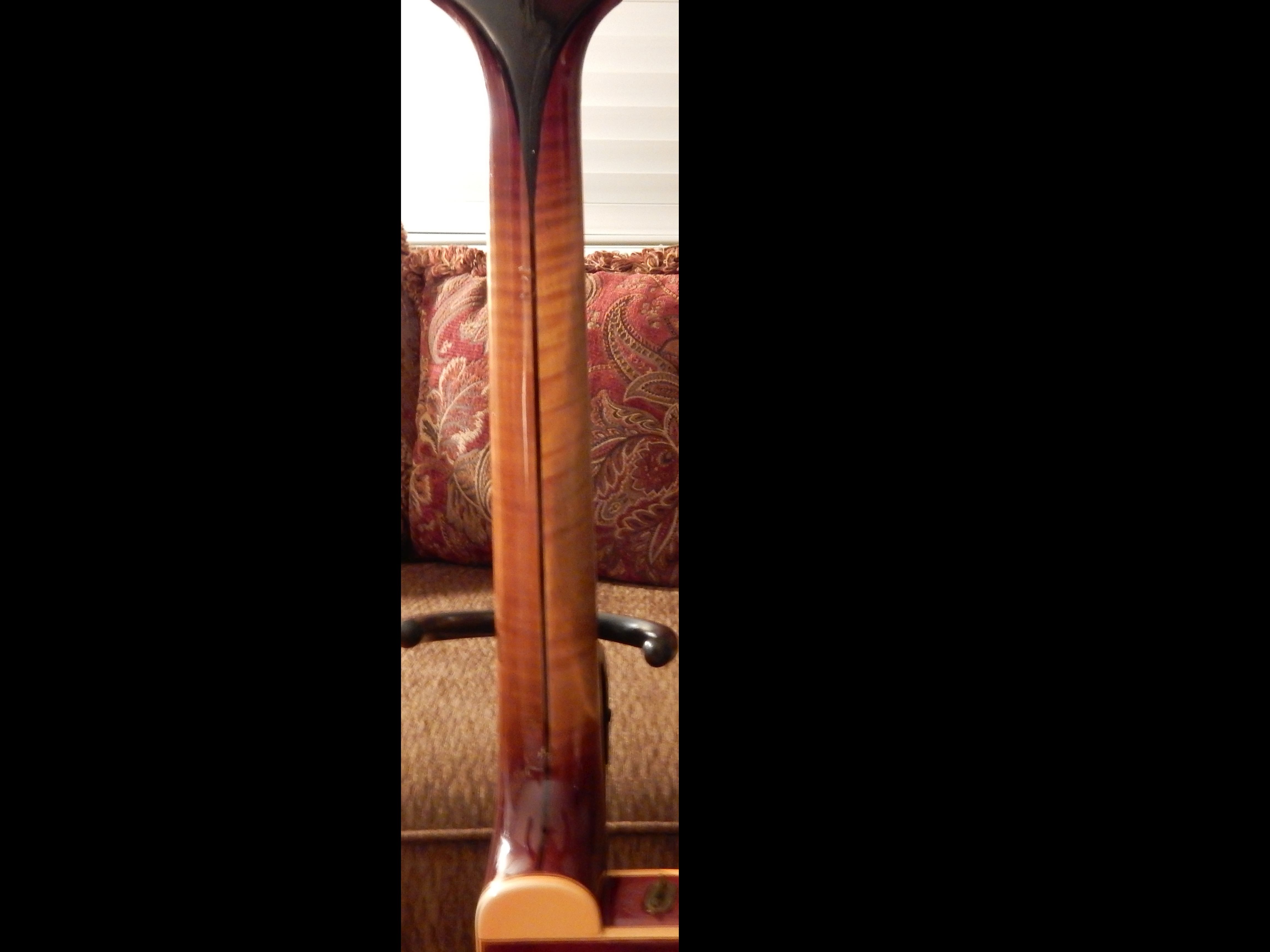
He wanted the guitar Cherryburst finish, made out of curly maple with a
very thin neck (20 frets about as wide as a tenor banjo). Hank said
Gibson was reluctant, Gibson said nobody would ever be interested in a
cherryburst Byrdland. Hank finally won with Gibson and they made the #3
Byrdland.
courtesy Youtube
Hank played the #3 at the sessions and later used it in a
performance with Elvis in Tupelo. In the video of that performance the guitar has either a Charlie
Christian or a Oscar Moore in the neck position, with a black cover on
the P90. Not long after this Gibson contacted Hank Garland and told him
they wanted to put the Cherryburst into the Gibson Archives. To our
knowledge, Hank had the original Custom pickup put back on the neck
position and put a cream/white cover on the P90. Gibson then sent the
Gibson salesman for that area to pick up the guitar.
In the 50's the salesman made all the deliveries, not via a big
truck like today. The salesman still had store deliveries to make,
before returning to the factory. One of his deliveries was, Allan Music
in Chattanooga, TN. When the delivery there was made, somehow the
salesman helper grabbed Hank's guitar and brought it in to the store (it
was a major mistake because, the case was covered with airline
stickers), but because of the mistake, the salesman sold the guitar to
Allen Music.
Charlie was at home eating lunch when the delivery was made. One
of Charlie's friends was in the store and called Charlie and described
the guitar hanging on the peg. Charlie came to the store and bought it
immediately.
Charlie bought the guitar in October of 1957. In November of 1957
Charlie went with the guitar to The Maxwell House in Nashville, Hank saw
him with the Guitar (knowing his case), he asked Charlie how did you get
my guitar, Charlie said, a salesman delivered to the store I work at and
I bought it, Charlie said Hank acted as if he was glad it didn't go back
to Gibson, he told Charlie "I'm glad you got it, have a seat and
I'll explain you the history about it", that's when Charlie learned
everything described above about the guitar. Charlie and Hank got to
know each other that day. In 1997 there was a big party for Hank,
Charlie came with the Byrdland, Hank smiled and said "I remember my
guitar". He then signed the guitar for Charlie.
In 1977 Charlie and his wife divorced, she got the guitar in the
divorce, so for the last 36 years the guitar has literally lived in the
case (climate controlled environment). Over the years his ex-wife let
him borrow the guitar for cutting cd's or special occasions (Hank
Garland's Party). So the guitar has lived 95% of it's life in the case,
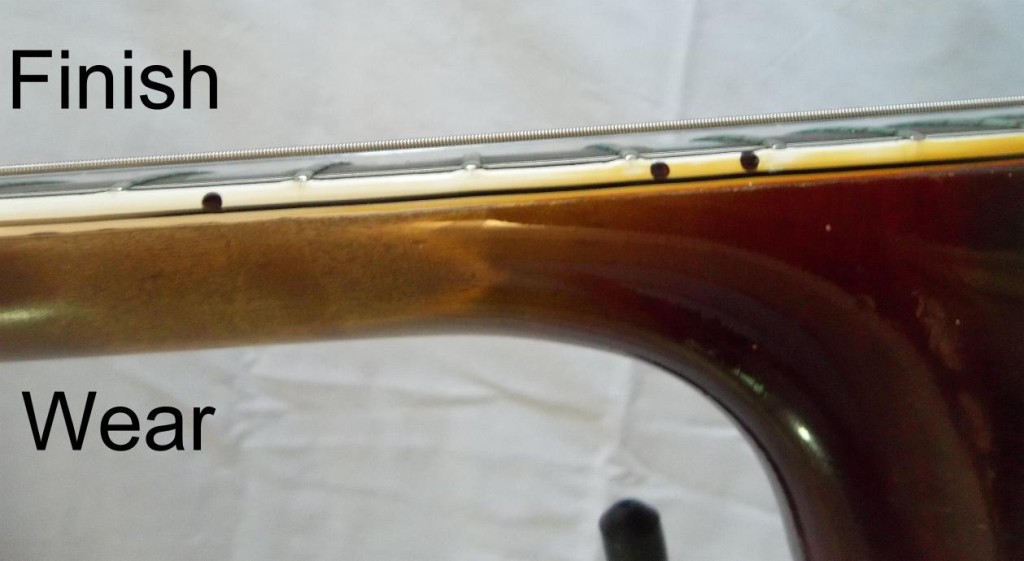
the guitar does have finish checkering (expected for a 58 year old
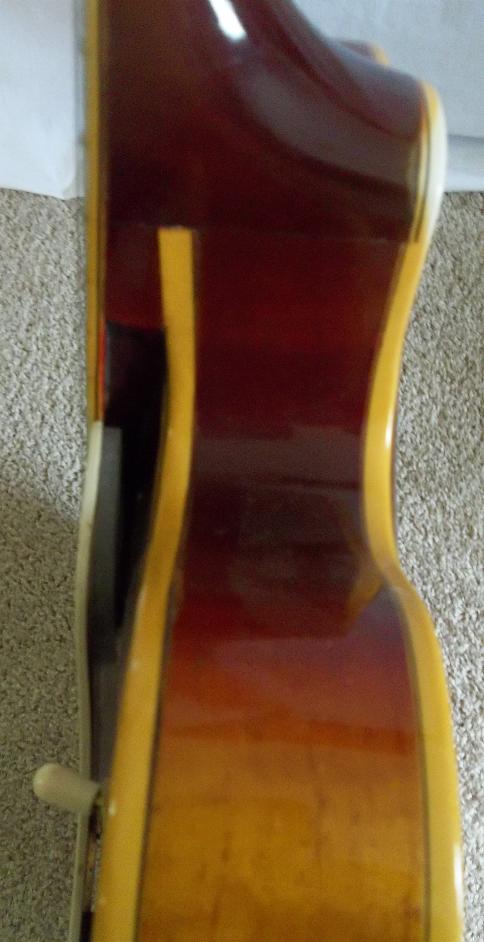
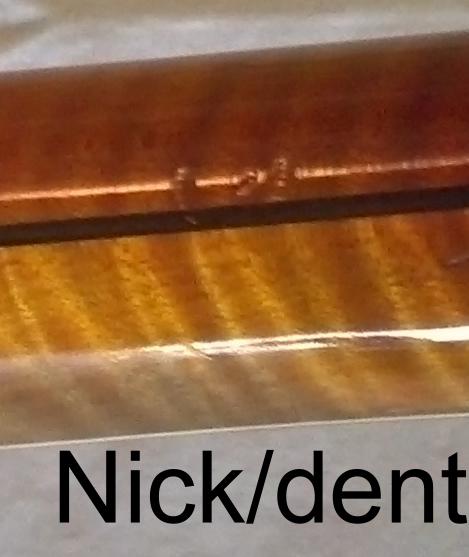
guitar), a few dings, a few scratches, the finish is 100% original,
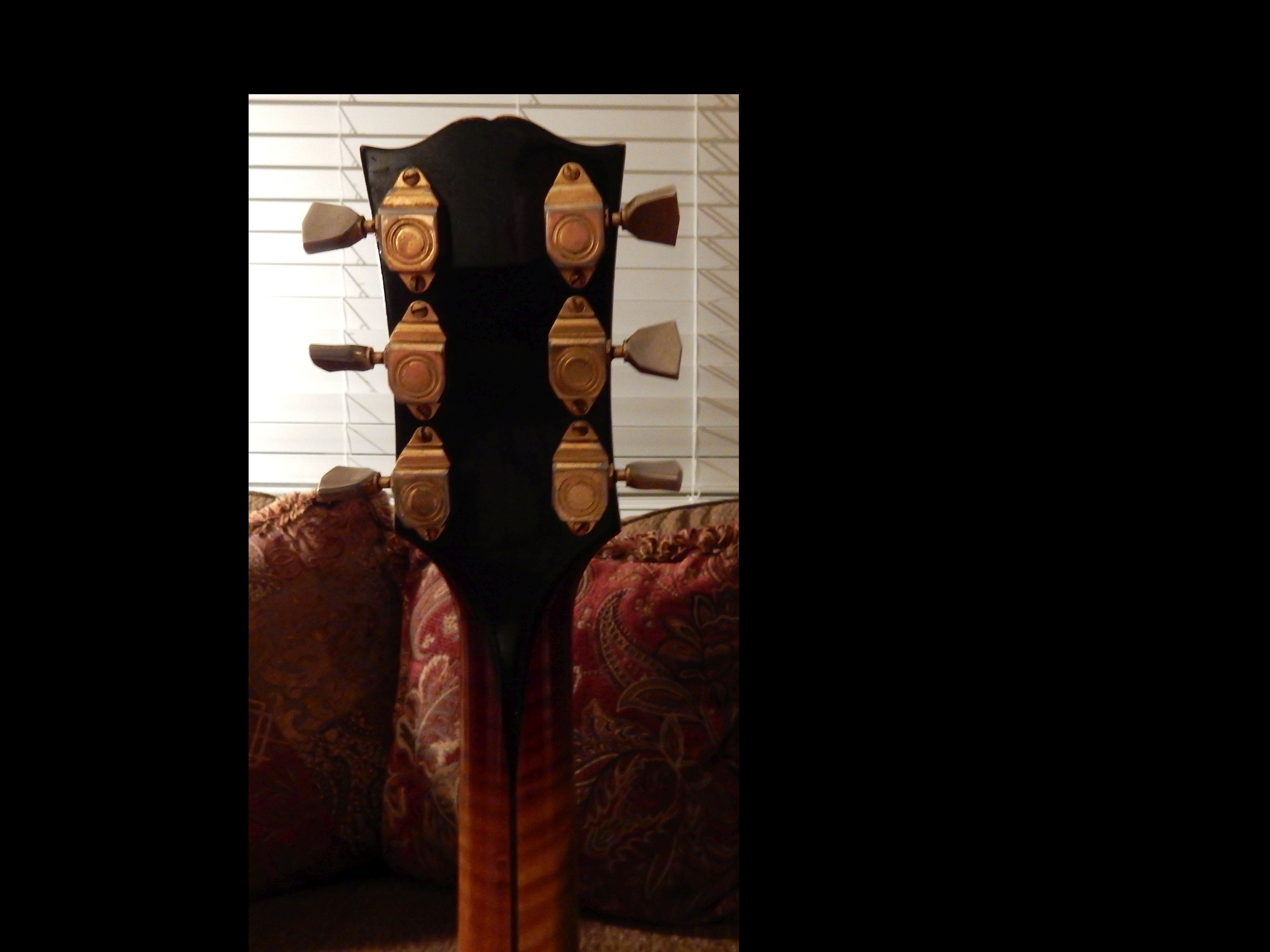
machine head keys are original. Charlie said Hank told him when got the
guitar he didn't like the sound of the custom pick-up in the neck
position (had a bass sound), Hank replaced it with a Charlie Christian
(back then they called them Oscar Moores?). When the guitar was put back
to original condition and Charlie bought it, he felt the same, then
replaced the custom pick-up with a Charlie Christian, but the
white/cream cover on the bridge pickup is original from 1957, when
Charlie bought it. Anything that is not original on the guitar is
included with the guitar (minus original truss cover and case). Charlie
put his own custom truss cover on the guitar.
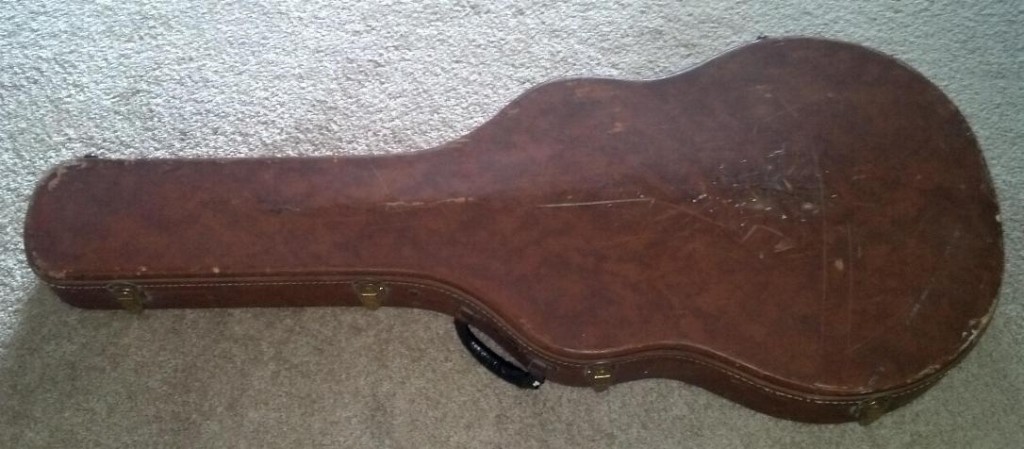
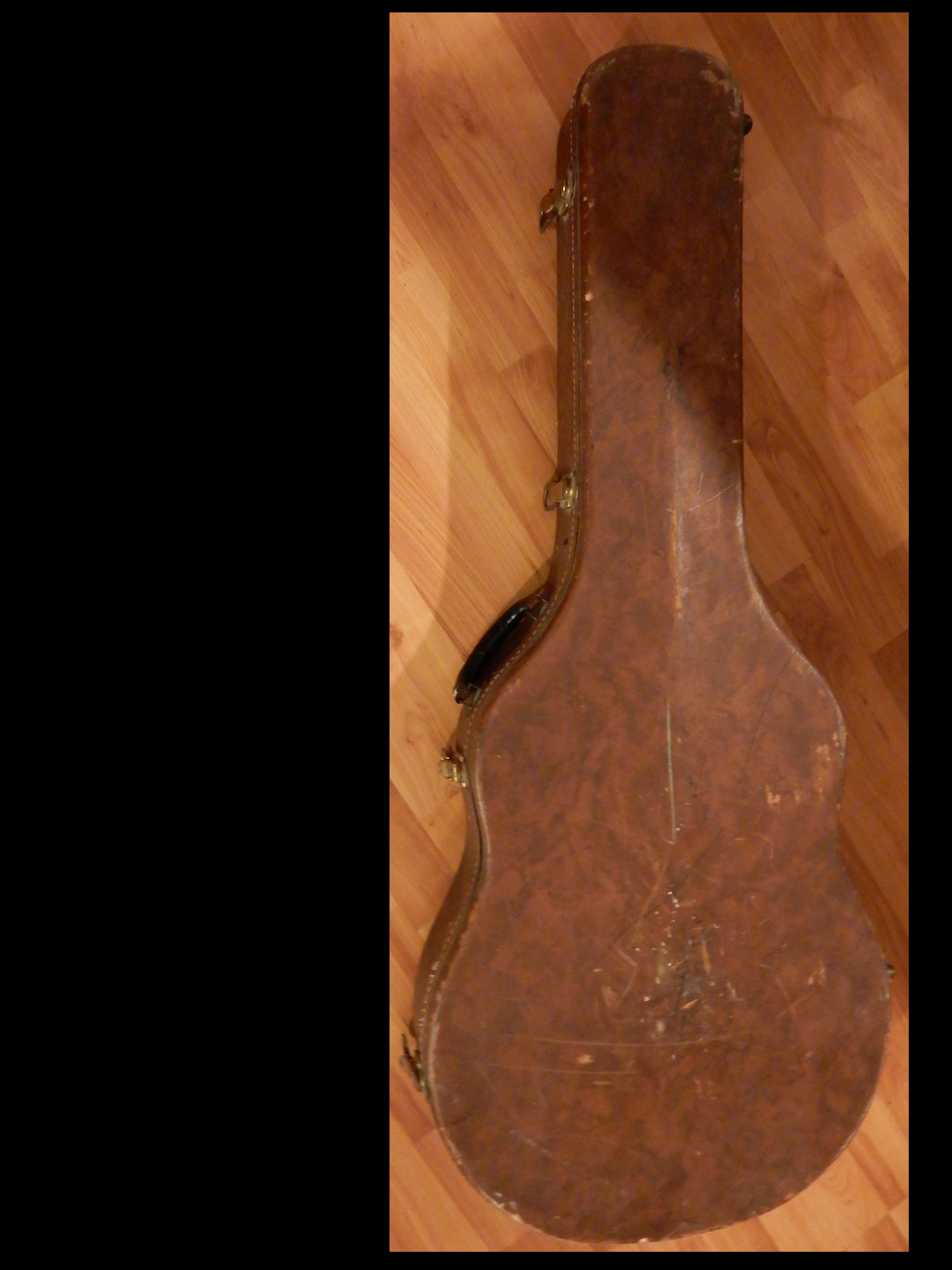
The original case was in rough shape because of all the travel it
had been through. Charlie replaced it with a new Byrdland case in 1957,
later the original case along with the nut cover were stolen. Charlies
wife is interested in selling the Guitar, once again it is a 1955 #3 of
3 made in 1955, (actual production started in 1956). Custom made for and
designed by Hank Garland, played on stage by Hank Garland for Elvis,
owned by Hank until 1957. Since 1957 it has been in the same family. I
can be contacted at arnoldae@comcast.net
I've been contacted by the people trying to sell this
guitar again with more pix and a price so as a favor to them and whoever
might be interested and ridiculously rich I agreed to put these up again
and let the fans know. Most of the info comes from the page(s) we wrote about
this guitar before and above and the contact
person is the same. As before, neither Scotty, myself or anyone
associated with the site has anything to do with the sale or handling of
this guitar, any and all correspondence should go to/through Allen.
In 1956 Gibson started the production of the Gibson Byrdland guitar. Billy Byrd and Hank Garland designed a jazz guitar for Gibson, it was called the Byrdland, Billy “byrd” and Hank Gar”land”, thus creating the
Byrdland.
In 1955 only three Gibson Byrdlands were made (production didn’t start until 1956). The first (#1) went to Billy Byrd, the second (#2) went to Hank Garland, then Hank told Gibson he wanted a custom Byrdland made, custom to his specifications, A cherry burst finish with a lot of tiger maple. Hank had to really work on Gibson to make it, Hank was told “nobody would buy a cherry burst Byrdland”, Hank persisted and Gibson made the #3 serial number A21762 (I personally contacted Gibson and was told A21762 was order #3 1955). Hank played the #3 at the sessions in Nashville at the studio’s, Hank was a “A” sessions player in the Nasville studio’s. There is a video on youtube, “Elvis Presley hound dog Tupelo goldsuit 1957”, Hank Garland is playing the #3 Byrdland in it. There are also some still shots of Hank Garland on stage with Elvis Presley, the picture is black and white but you can see it’s a sunburst with the white pick guard. The only Byrdland with White pick guards is the 1955 (both of Hanks Garland’s 55’s have white pickup guards. In late 1957 Gibson contacted Hank and told him they wanted to put the Cherry burst #3 Byrdland in the Gibson archives. In the 50’s Gibson’s salesmen delivered to the stores going anywhere near Nashville instead of shipping trucks (like they deliver now). So the Gibson salesperson went to Hanks house to pickup the #3 cherry burst Byrdland, after picking up the #3, the salesman still had some deliveries to make, one of those deliveries was Allen Music in Chattanooga Tennessee. When the salesman got to Allen Music to make the delivery, his helper
accidentally unloaded Hanks #3 (makes no sense because the case was in rough shape from all the traveling it did, plus the case was covered with travel stickers and tags) and it was sold as new stock to Allen Music. So technically Allen Music bought Hank Garlands guitar.
In 1957 Charlie Chambers was a Guitar teacher at Allen Music and “B” sessions player in the Nashville studios. Hank was Charlies Idol, many times Charlie would hang around the studio’s just to listen to Hank play.
Charlie made it a point to try to “play like Hank”. When Hanks guitar was sold to Allen Music, Charlie was at home eating lunch. Charlie got a phone call from one of his buddies about a Gibson Cherry burst Byrdland with a white pickup guard being delivered to the store, Charlie dropped everything, went to the store and bought the Byrdland. By the time Gibson realized what happened, the guitar had been sold, there was no way Charlie would let go of it. In November 1957 Charlie took the guitar to the Maxwell house in Nashville. Once he got there Chet Atkins and Patsy Cline both said “how did you get Hanks guitar?”, Charlie simply said “I bought it”.
Finally Hank saw Charlie carrying the case covered with his travel stickers. Hank asked him “how did you get my guitar?”. Charlie said “it was delivered to the store I work at and I bought it”. Charlie said hanks wasn’t mad he was glad it didn’t go back to Gibson, Hank told him “you bought it it’s yours, sit down and I’ll tell the history about it”.
Before Charlie bought the guitar it was put back into original condition before it went to Gibson. Charlie said Hank didn’t like the sound of the bridge pickup and changed it to a P90 with a black cover. Once Charlie got the guitar in original condition, he felt the same way and changed it also, but put a cream colored cover on it. After purchasing the guitar, Charlie put a custom truss rod cover with “Charles Chambers” on it, the original truss rod cover went into the case. One day the original case was stolen (luckily the guitar was not in it), When this happened Charlie bought a new late (Charlie thinks it’s a 59) case. Around 1977 Charlie and his wife got a divorce, in the divorce his ex-wife took the #3 Gibson Byrdland, once in a blue moon Charlie would get to use the guitar to cut a CD. In 1997 there was a big party for Hank Garland, Charlie took the guitar to Hank’s party. Hank smiled and said I see you still got the guitar. At that time Hank signed the guitar for Charlie “Best wishes Hank Garland”. The Garland family knew Charlie, Charlie says he loves the Garland family. There is a blog out where Billy garland say’s he was there when Hank signed the guitar.
The guitar has literally lived in the case since the late 70’s. rarely ever played. The finish is original, it has a little checkering, but the finish still looks great. Every original part that has been changed on the guitar comes with the guitar (except the truss rod cover and the original case which was stolen).
Charlie’s ex wife has finally decided to sell the #3 Gibson Byrdland, once owned by Hank Garland, played on stage with Elvis by Hank. They are asking $225,000 for the guitar. This is a one of a kind, the only 1955 Cherry burst, the only custom ordered, only three total made in 1955.
Please note that neither Scotty Moore
or anyone affiliated with his website have anything to do with the sale of this guitar
or the authenticity of its history presented. We are glad though to
present it here for any and all interested parties.
All photos on this page unless
otherwise indicated are the property of the designated persons or
company, any unauthorized use or reproduction is prohibited.